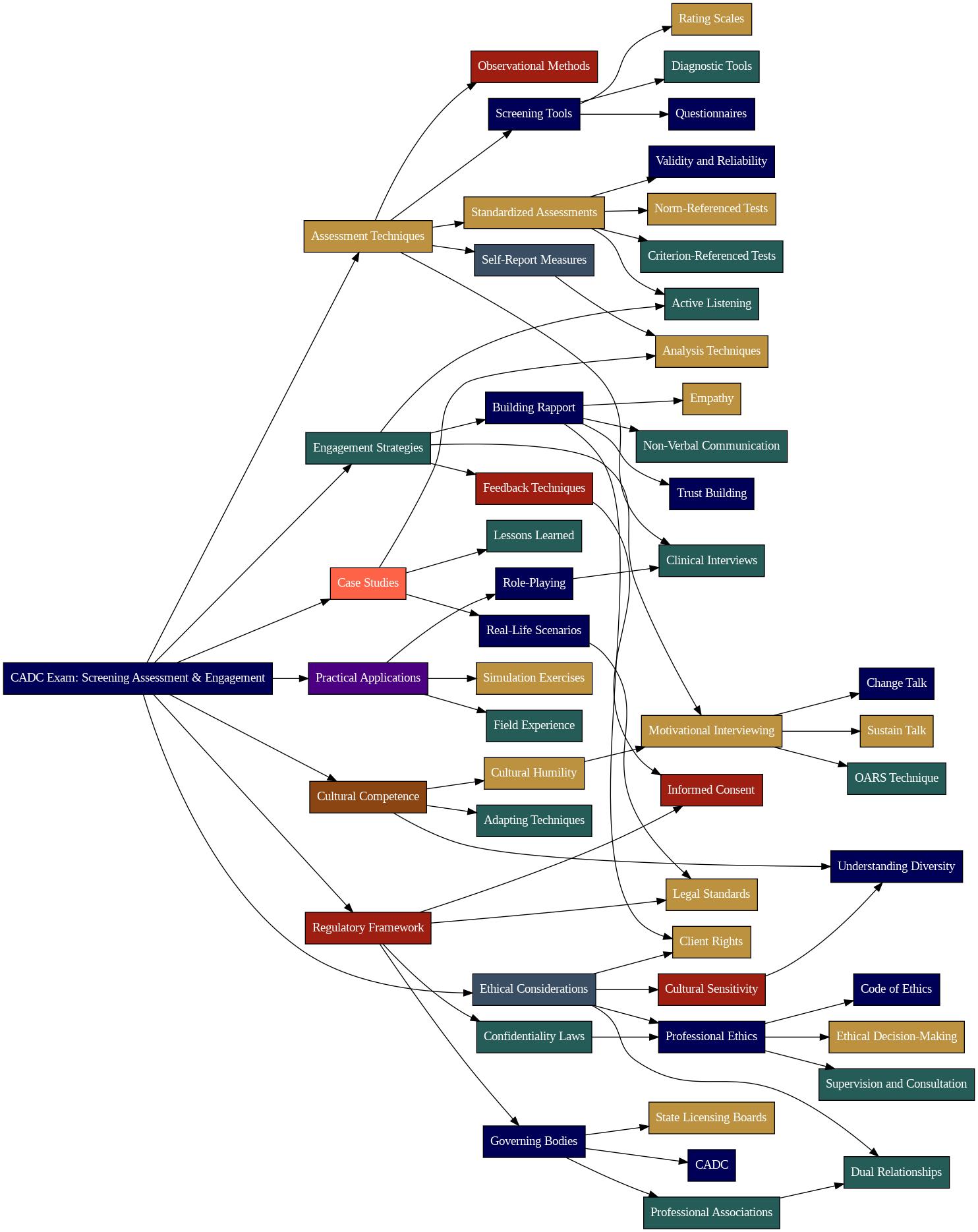
Quiz-summary
0 of 29 questions completed
Questions:
- 1
- 2
- 3
- 4
- 5
- 6
- 7
- 8
- 9
- 10
- 11
- 12
- 13
- 14
- 15
- 16
- 17
- 18
- 19
- 20
- 21
- 22
- 23
- 24
- 25
- 26
- 27
- 28
- 29
Information
Premium Practice Questions
You have already completed the quiz before. Hence you can not start it again.
Quiz is loading...
You must sign in or sign up to start the quiz.
You have to finish following quiz, to start this quiz:
Results
0 of 29 questions answered correctly
Your time:
Time has elapsed
Categories
- Not categorized 0%
- 1
- 2
- 3
- 4
- 5
- 6
- 7
- 8
- 9
- 10
- 11
- 12
- 13
- 14
- 15
- 16
- 17
- 18
- 19
- 20
- 21
- 22
- 23
- 24
- 25
- 26
- 27
- 28
- 29
- Answered
- Review
-
Question 1 of 29
1. Question
A 16-year-old client, enrolled in a substance use treatment program in Missouri, discloses to their CADC that their parent regularly uses marijuana in the home and occasionally leaves them unsupervised for extended periods while under the influence. The client states they feel uncomfortable but are not in immediate physical danger. According to Missouri’s ethical and legal guidelines for CADCs, what is the MOST appropriate course of action for the counselor?
Correct
Missouri Certified Alcohol and Drug Counselors (CADCs) must adhere to strict ethical guidelines regarding confidentiality, especially when dealing with clients who are minors. While generally, client information is protected under both federal (42 CFR Part 2) and state laws, exceptions exist, particularly concerning child abuse or neglect. In Missouri, mandated reporting laws require professionals, including CADCs, to report any reasonable suspicion of child abuse or neglect to the Missouri Children’s Division. This obligation supersedes general confidentiality rules. The determination of “reasonable suspicion” is crucial and requires careful consideration of the presenting information and the potential harm to the child. Consultation with supervisors, legal counsel, or ethics experts is advisable in complex cases to ensure compliance with both ethical and legal mandates. Failure to report suspected child abuse can result in legal penalties and ethical sanctions. Furthermore, CADCs should proactively inform minor clients and their guardians about the limits of confidentiality at the outset of treatment, including the mandated reporting requirements. This transparency helps to build trust and manage expectations, even when difficult disclosures are necessary.
Incorrect
Missouri Certified Alcohol and Drug Counselors (CADCs) must adhere to strict ethical guidelines regarding confidentiality, especially when dealing with clients who are minors. While generally, client information is protected under both federal (42 CFR Part 2) and state laws, exceptions exist, particularly concerning child abuse or neglect. In Missouri, mandated reporting laws require professionals, including CADCs, to report any reasonable suspicion of child abuse or neglect to the Missouri Children’s Division. This obligation supersedes general confidentiality rules. The determination of “reasonable suspicion” is crucial and requires careful consideration of the presenting information and the potential harm to the child. Consultation with supervisors, legal counsel, or ethics experts is advisable in complex cases to ensure compliance with both ethical and legal mandates. Failure to report suspected child abuse can result in legal penalties and ethical sanctions. Furthermore, CADCs should proactively inform minor clients and their guardians about the limits of confidentiality at the outset of treatment, including the mandated reporting requirements. This transparency helps to build trust and manage expectations, even when difficult disclosures are necessary.
-
Question 2 of 29
2. Question
A Missouri CADC, Kenisha, is working with a client, Darrel, who is struggling with opioid addiction. During a session, Darrel discloses that he occasionally leaves his 6-year-old child, Marcus, unattended at home for short periods while he goes to purchase drugs. Darrel assures Kenisha that Marcus is never in any real danger and that he only leaves him for about 30 minutes at a time. According to Missouri law and ethical guidelines, what is Kenisha’s MOST appropriate course of action?
Correct
Missouri Certified Alcohol and Drug Counselors (CADCs) operate within a framework defined by ethical guidelines, legal statutes, and professional standards. A critical aspect of this framework involves mandated reporting, particularly concerning child abuse and neglect. Missouri Revised Statutes (specifically Chapter 210, Child Protection and Reformation) outlines the specific requirements for reporting suspected child abuse or neglect. These statutes mandate that certain professionals, including counselors, must report when they have reasonable cause to suspect that a child has been subjected to abuse or neglect. “Reasonable cause” doesn’t necessitate absolute proof but requires a level of suspicion based on credible information. The report must be made to the Missouri Children’s Division. Failure to report suspected child abuse or neglect can result in legal penalties for the counselor. The counselor’s primary duty is to the safety and well-being of the child, overriding confidentiality concerns in such situations. However, the counselor must still adhere to ethical principles by documenting the rationale for the report and maintaining client confidentiality to the extent possible, given the legal obligation. Furthermore, CADCs need to be aware of the specific procedures for making a report, including the information required by the Children’s Division and the timelines for reporting. They also need to understand the protections afforded to reporters under the law, such as immunity from liability in certain circumstances. Understanding the nuances of Missouri’s child abuse reporting laws is crucial for ethical and legally sound practice.
Incorrect
Missouri Certified Alcohol and Drug Counselors (CADCs) operate within a framework defined by ethical guidelines, legal statutes, and professional standards. A critical aspect of this framework involves mandated reporting, particularly concerning child abuse and neglect. Missouri Revised Statutes (specifically Chapter 210, Child Protection and Reformation) outlines the specific requirements for reporting suspected child abuse or neglect. These statutes mandate that certain professionals, including counselors, must report when they have reasonable cause to suspect that a child has been subjected to abuse or neglect. “Reasonable cause” doesn’t necessitate absolute proof but requires a level of suspicion based on credible information. The report must be made to the Missouri Children’s Division. Failure to report suspected child abuse or neglect can result in legal penalties for the counselor. The counselor’s primary duty is to the safety and well-being of the child, overriding confidentiality concerns in such situations. However, the counselor must still adhere to ethical principles by documenting the rationale for the report and maintaining client confidentiality to the extent possible, given the legal obligation. Furthermore, CADCs need to be aware of the specific procedures for making a report, including the information required by the Children’s Division and the timelines for reporting. They also need to understand the protections afforded to reporters under the law, such as immunity from liability in certain circumstances. Understanding the nuances of Missouri’s child abuse reporting laws is crucial for ethical and legally sound practice.
-
Question 3 of 29
3. Question
A CADC in Missouri is counseling a client with a substance use disorder. During a session, the client discloses that they were sexually abused as a child by a family member, but emphasize that the abuse occurred many years ago and is no longer ongoing. Considering the ethical and legal obligations under Missouri law and 42 CFR Part 2, what is the MOST appropriate initial course of action for the counselor?
Correct
In Missouri, counselors working with individuals with substance use disorders must adhere to both federal and state regulations regarding confidentiality, particularly 42 CFR Part 2, which governs the confidentiality of alcohol and drug abuse patient records. This federal law is stricter than HIPAA in certain aspects, especially concerning redisclosure. Missouri state law also has its own confidentiality provisions that counselors must be aware of. When a client discloses past child abuse, the counselor must navigate these confidentiality rules in conjunction with Missouri’s mandated reporting laws. Missouri Revised Statutes (MRS) § 210.115 mandates that certain professionals, including counselors, report suspected child abuse or neglect. The critical decision involves balancing the duty to protect a child from harm (mandated reporting) with the client’s right to confidentiality under 42 CFR Part 2 and Missouri state law. Because the abuse is past, the immediate safety of a child is not at risk. Therefore, the counselor must first seek a release from the client to report the past abuse, carefully documenting the rationale for the decision and the consultation with supervisors or legal counsel. If the client refuses to sign a release, the counselor must carefully weigh the ethical and legal obligations, potentially consulting with legal counsel or the Missouri Credentialing Board to determine the appropriate course of action. The counselor should also explore with the client the reasons for their reluctance to report and offer support in making a report themselves.
Incorrect
In Missouri, counselors working with individuals with substance use disorders must adhere to both federal and state regulations regarding confidentiality, particularly 42 CFR Part 2, which governs the confidentiality of alcohol and drug abuse patient records. This federal law is stricter than HIPAA in certain aspects, especially concerning redisclosure. Missouri state law also has its own confidentiality provisions that counselors must be aware of. When a client discloses past child abuse, the counselor must navigate these confidentiality rules in conjunction with Missouri’s mandated reporting laws. Missouri Revised Statutes (MRS) § 210.115 mandates that certain professionals, including counselors, report suspected child abuse or neglect. The critical decision involves balancing the duty to protect a child from harm (mandated reporting) with the client’s right to confidentiality under 42 CFR Part 2 and Missouri state law. Because the abuse is past, the immediate safety of a child is not at risk. Therefore, the counselor must first seek a release from the client to report the past abuse, carefully documenting the rationale for the decision and the consultation with supervisors or legal counsel. If the client refuses to sign a release, the counselor must carefully weigh the ethical and legal obligations, potentially consulting with legal counsel or the Missouri Credentialing Board to determine the appropriate course of action. The counselor should also explore with the client the reasons for their reluctance to report and offer support in making a report themselves.
-
Question 4 of 29
4. Question
A CADC in Missouri obtains written consent from a client to communicate with the client’s primary care physician (PCP) regarding their substance use treatment. The PCP subsequently wants to share this information with a specialist for consultation. According to 42 CFR Part 2, what is the MOST appropriate course of action?
Correct
This question assesses understanding of 42 CFR Part 2, a crucial federal regulation governing the confidentiality of substance use disorder patient records. 42 CFR Part 2 is stricter than HIPAA in some respects, particularly regarding the redisclosure of information. It generally prohibits the disclosure of patient information without the patient’s written consent, even to other healthcare providers, unless specific exceptions apply. In this scenario, the client has provided written consent for the CADC to communicate with their primary care physician (PCP) regarding their substance use treatment. However, the PCP then wants to share this information with a specialist for consultation. Under 42 CFR Part 2, the PCP cannot redisclose the information to the specialist without obtaining separate written consent from the client. The original consent only authorized the CADC to share information with the PCP, not for the PCP to further disseminate it. The CADC should advise the PCP that they need to obtain separate written consent from the client before sharing any information about their substance use treatment with the specialist. This ensures compliance with federal law and protects the client’s confidentiality.
Incorrect
This question assesses understanding of 42 CFR Part 2, a crucial federal regulation governing the confidentiality of substance use disorder patient records. 42 CFR Part 2 is stricter than HIPAA in some respects, particularly regarding the redisclosure of information. It generally prohibits the disclosure of patient information without the patient’s written consent, even to other healthcare providers, unless specific exceptions apply. In this scenario, the client has provided written consent for the CADC to communicate with their primary care physician (PCP) regarding their substance use treatment. However, the PCP then wants to share this information with a specialist for consultation. Under 42 CFR Part 2, the PCP cannot redisclose the information to the specialist without obtaining separate written consent from the client. The original consent only authorized the CADC to share information with the PCP, not for the PCP to further disseminate it. The CADC should advise the PCP that they need to obtain separate written consent from the client before sharing any information about their substance use treatment with the specialist. This ensures compliance with federal law and protects the client’s confidentiality.
-
Question 5 of 29
5. Question
Aisha, a CADC in Missouri, is working with Kenji, a recent immigrant from Japan, who is in treatment for alcohol use disorder. Kenji seems reluctant to discuss his family life during counseling sessions. What is Aisha’s MOST culturally competent response?
Correct
Cultural competence in counseling involves understanding and respecting the diverse values, beliefs, and experiences of clients from different cultural backgrounds. It goes beyond simply being aware of cultural differences; it requires actively adapting counseling approaches to meet the unique needs of each client. This includes considering factors such as race, ethnicity, religion, socioeconomic status, sexual orientation, gender identity, and disability. A culturally competent counselor recognizes their own biases and assumptions and how these might impact the counseling process. In the scenario, the counselor, Aisha, is working with a client, Kenji, who is a recent immigrant from Japan. Kenji expresses reluctance to discuss his family life, which is a common cultural difference as some cultures value privacy. Aisha’s most appropriate response is to acknowledge and respect Kenji’s cultural background and to explore his comfort level in discussing family matters. Forcing Kenji to disclose information he is not comfortable sharing would be a violation of his cultural values and could damage the therapeutic relationship. Instead, Aisha can gradually build trust and rapport, while also educating herself about Japanese culture and communication styles. She can also explore how Kenji’s cultural background might be influencing his substance use and recovery process.
Incorrect
Cultural competence in counseling involves understanding and respecting the diverse values, beliefs, and experiences of clients from different cultural backgrounds. It goes beyond simply being aware of cultural differences; it requires actively adapting counseling approaches to meet the unique needs of each client. This includes considering factors such as race, ethnicity, religion, socioeconomic status, sexual orientation, gender identity, and disability. A culturally competent counselor recognizes their own biases and assumptions and how these might impact the counseling process. In the scenario, the counselor, Aisha, is working with a client, Kenji, who is a recent immigrant from Japan. Kenji expresses reluctance to discuss his family life, which is a common cultural difference as some cultures value privacy. Aisha’s most appropriate response is to acknowledge and respect Kenji’s cultural background and to explore his comfort level in discussing family matters. Forcing Kenji to disclose information he is not comfortable sharing would be a violation of his cultural values and could damage the therapeutic relationship. Instead, Aisha can gradually build trust and rapport, while also educating herself about Japanese culture and communication styles. She can also explore how Kenji’s cultural background might be influencing his substance use and recovery process.
-
Question 6 of 29
6. Question
A Certified Alcohol and Drug Counselor (CADC) in Missouri is working with Maria, an adult client, who discloses that she is experiencing ongoing domestic abuse by her partner. Maria explicitly requests that the counselor not report the abuse to anyone. They have a 6 year old child together. Under Missouri law and ethical guidelines for CADCs, what is the MOST appropriate course of action for the counselor?
Correct
In Missouri, a CADC encountering a client, Maria, who discloses ongoing domestic abuse by her partner presents a complex ethical dilemma requiring careful navigation of confidentiality, client safety, and legal obligations. The core principle is prioritizing Maria’s safety while adhering to Missouri’s specific mandated reporting laws. Missouri Revised Statutes, specifically Chapter 210, outlines mandated reporting requirements for suspected child abuse or neglect. While Maria herself is not a child, the presence of children in the household where domestic violence is occurring can trigger mandated reporting if there is reasonable cause to suspect the children are being abused or neglected. This is because witnessing domestic violence is considered a form of child maltreatment in many jurisdictions, including Missouri, as it can cause significant emotional and psychological harm. The CADC must also consider Maria’s autonomy and right to self-determination. Simply reporting the abuse without Maria’s consent could jeopardize her safety and erode trust in the therapeutic relationship. Therefore, the CADC should first explore with Maria the potential risks and benefits of reporting, empowering her to make an informed decision. This includes discussing safety planning strategies, such as identifying safe places to go, developing a code word with trusted individuals, and gathering essential documents. If Maria refuses to allow a report and the CADC does not have reasonable cause to suspect direct child abuse or neglect, the CADC must respect Maria’s confidentiality while continuing to provide support and resources. However, if the CADC has reasonable cause to believe that the children are at risk of harm due to witnessing the domestic violence, the CADC has a legal and ethical obligation to report to the Missouri Department of Social Services, Children’s Division. This decision should be made in consultation with a supervisor or legal counsel to ensure compliance with all applicable laws and ethical guidelines. The CADC must document all steps taken, including the rationale for the decision to report or not report, to protect themselves legally and ethically. Failing to report suspected child abuse or neglect can result in legal penalties for the CADC in Missouri.
Incorrect
In Missouri, a CADC encountering a client, Maria, who discloses ongoing domestic abuse by her partner presents a complex ethical dilemma requiring careful navigation of confidentiality, client safety, and legal obligations. The core principle is prioritizing Maria’s safety while adhering to Missouri’s specific mandated reporting laws. Missouri Revised Statutes, specifically Chapter 210, outlines mandated reporting requirements for suspected child abuse or neglect. While Maria herself is not a child, the presence of children in the household where domestic violence is occurring can trigger mandated reporting if there is reasonable cause to suspect the children are being abused or neglected. This is because witnessing domestic violence is considered a form of child maltreatment in many jurisdictions, including Missouri, as it can cause significant emotional and psychological harm. The CADC must also consider Maria’s autonomy and right to self-determination. Simply reporting the abuse without Maria’s consent could jeopardize her safety and erode trust in the therapeutic relationship. Therefore, the CADC should first explore with Maria the potential risks and benefits of reporting, empowering her to make an informed decision. This includes discussing safety planning strategies, such as identifying safe places to go, developing a code word with trusted individuals, and gathering essential documents. If Maria refuses to allow a report and the CADC does not have reasonable cause to suspect direct child abuse or neglect, the CADC must respect Maria’s confidentiality while continuing to provide support and resources. However, if the CADC has reasonable cause to believe that the children are at risk of harm due to witnessing the domestic violence, the CADC has a legal and ethical obligation to report to the Missouri Department of Social Services, Children’s Division. This decision should be made in consultation with a supervisor or legal counsel to ensure compliance with all applicable laws and ethical guidelines. The CADC must document all steps taken, including the rationale for the decision to report or not report, to protect themselves legally and ethically. Failing to report suspected child abuse or neglect can result in legal penalties for the CADC in Missouri.
-
Question 7 of 29
7. Question
A Certified Alcohol and Drug Counselor (CADC) in Missouri is leading a group therapy session. A client discloses they are actively selling diverted prescription opioids to fund their addiction. Considering Missouri’s legal and ethical guidelines for CADCs, what is the MOST appropriate initial course of action for the counselor?
Correct
In Missouri, a CADC encounters a situation where a client, during a group therapy session, reveals they are actively selling diverted prescription opioids to support their own habit. The client’s actions directly violate state and federal laws regarding controlled substances. Missouri Revised Statutes Chapter 195 addresses drug regulations and enforcement. While confidentiality is paramount, Missouri law, aligning with federal guidelines such as 42 CFR Part 2 (if applicable based on the funding source of the program), allows for breaches of confidentiality when there is a clear and immediate threat to the safety and welfare of others, or when legally mandated. The counselor must weigh their ethical obligations to protect client confidentiality against their legal and ethical duty to prevent harm and uphold the law. The counselor should first consult with a supervisor and legal counsel to determine the best course of action. Options include: attempting to persuade the client to self-report to authorities, reporting the information to law enforcement while minimizing the disclosed information to only what is necessary to prevent further illegal activity and harm, or seeking a court order to disclose the information. Failing to act could result in legal repercussions for the counselor and potential harm to the community. The decision-making process must be documented thoroughly, reflecting the ethical considerations and legal advice received.
Incorrect
In Missouri, a CADC encounters a situation where a client, during a group therapy session, reveals they are actively selling diverted prescription opioids to support their own habit. The client’s actions directly violate state and federal laws regarding controlled substances. Missouri Revised Statutes Chapter 195 addresses drug regulations and enforcement. While confidentiality is paramount, Missouri law, aligning with federal guidelines such as 42 CFR Part 2 (if applicable based on the funding source of the program), allows for breaches of confidentiality when there is a clear and immediate threat to the safety and welfare of others, or when legally mandated. The counselor must weigh their ethical obligations to protect client confidentiality against their legal and ethical duty to prevent harm and uphold the law. The counselor should first consult with a supervisor and legal counsel to determine the best course of action. Options include: attempting to persuade the client to self-report to authorities, reporting the information to law enforcement while minimizing the disclosed information to only what is necessary to prevent further illegal activity and harm, or seeking a court order to disclose the information. Failing to act could result in legal repercussions for the counselor and potential harm to the community. The decision-making process must be documented thoroughly, reflecting the ethical considerations and legal advice received.
-
Question 8 of 29
8. Question
A newly certified CADC in Missouri, Javier, is working with a client, Maria, who is hesitant to disclose details about her substance use due to cultural beliefs about shame and family honor. Javier, eager to build rapport, assures Maria that everything discussed will remain strictly confidential, without fully explaining the exceptions to confidentiality under Missouri law, such as mandated reporting of child abuse or threats of harm to self or others. He also accepts a small gift of homemade tamales from Maria as a token of appreciation. Which of the following ethical principles has Javier potentially violated?
Correct
According to Missouri’s regulations for Certified Alcohol and Drug Counselors (CADCs), specifically within the context of ethical guidelines and client rights, a CADC must prioritize the client’s well-being and autonomy. This includes ensuring that clients are fully informed about the nature of the counseling process, potential risks and benefits, alternatives to counseling, the counselor’s qualifications, and the client’s right to confidentiality and its limitations. The concept of informed consent is not merely a formality but a continuous process that allows clients to make informed decisions about their treatment. In Missouri, counselors are also obligated to adhere to both state laws and ethical codes established by professional organizations such as the Missouri Substance Abuse Professional Certification Board (MOSAPCB). This board is responsible for certifying substance abuse professionals and ensuring they follow ethical standards. A critical aspect of ethical practice involves recognizing and addressing potential conflicts of interest, including dual relationships. Missouri CADCs must avoid situations where their personal or professional interests could compromise their objectivity, competence, or effectiveness in serving their clients. Failing to adequately obtain informed consent or engaging in dual relationships could lead to ethical violations, disciplinary actions by the MOSAPCB, and potential legal ramifications. Cultural competence is also paramount, requiring counselors to understand and respect the cultural backgrounds of their clients, adapting their counseling approaches to meet the unique needs of diverse populations within Missouri. This includes being aware of cultural beliefs, values, and practices related to substance use and recovery.
Incorrect
According to Missouri’s regulations for Certified Alcohol and Drug Counselors (CADCs), specifically within the context of ethical guidelines and client rights, a CADC must prioritize the client’s well-being and autonomy. This includes ensuring that clients are fully informed about the nature of the counseling process, potential risks and benefits, alternatives to counseling, the counselor’s qualifications, and the client’s right to confidentiality and its limitations. The concept of informed consent is not merely a formality but a continuous process that allows clients to make informed decisions about their treatment. In Missouri, counselors are also obligated to adhere to both state laws and ethical codes established by professional organizations such as the Missouri Substance Abuse Professional Certification Board (MOSAPCB). This board is responsible for certifying substance abuse professionals and ensuring they follow ethical standards. A critical aspect of ethical practice involves recognizing and addressing potential conflicts of interest, including dual relationships. Missouri CADCs must avoid situations where their personal or professional interests could compromise their objectivity, competence, or effectiveness in serving their clients. Failing to adequately obtain informed consent or engaging in dual relationships could lead to ethical violations, disciplinary actions by the MOSAPCB, and potential legal ramifications. Cultural competence is also paramount, requiring counselors to understand and respect the cultural backgrounds of their clients, adapting their counseling approaches to meet the unique needs of diverse populations within Missouri. This includes being aware of cultural beliefs, values, and practices related to substance use and recovery.
-
Question 9 of 29
9. Question
A CADC in Missouri is working with a client, Sarah, at a federally funded substance use treatment center. Sarah requests that her treatment records be shared with her primary care physician to coordinate her overall healthcare. Which of the following steps MUST the CADC take to comply with 42 CFR Part 2 regulations regarding confidentiality?
Correct
42 CFR Part 2 is a federal regulation that protects the confidentiality of patient records created by federally assisted substance use disorder programs. It is stricter than HIPAA in some respects and applies specifically to programs that receive federal funding for substance use treatment. In Missouri, as in other states, CADCs working in such programs must be intimately familiar with 42 CFR Part 2 and its requirements. The regulation generally prohibits the disclosure of patient information without the patient’s written consent. However, there are exceptions, such as disclosures for medical emergencies, research (with specific protocols), and audits or evaluations. Even in these cases, the disclosure must be limited to the minimum necessary information. In the scenario, the client, Sarah, has requested that her treatment records be shared with her primary care physician. To comply with 42 CFR Part 2, the CADC must obtain Sarah’s written consent using a specific form that meets the requirements of the regulation. This form must include elements like the specific information to be disclosed, the purpose of the disclosure, the recipient of the information, and the expiration date of the consent. The CADC must also inform Sarah that she can revoke her consent at any time.
Incorrect
42 CFR Part 2 is a federal regulation that protects the confidentiality of patient records created by federally assisted substance use disorder programs. It is stricter than HIPAA in some respects and applies specifically to programs that receive federal funding for substance use treatment. In Missouri, as in other states, CADCs working in such programs must be intimately familiar with 42 CFR Part 2 and its requirements. The regulation generally prohibits the disclosure of patient information without the patient’s written consent. However, there are exceptions, such as disclosures for medical emergencies, research (with specific protocols), and audits or evaluations. Even in these cases, the disclosure must be limited to the minimum necessary information. In the scenario, the client, Sarah, has requested that her treatment records be shared with her primary care physician. To comply with 42 CFR Part 2, the CADC must obtain Sarah’s written consent using a specific form that meets the requirements of the regulation. This form must include elements like the specific information to be disclosed, the purpose of the disclosure, the recipient of the information, and the expiration date of the consent. The CADC must also inform Sarah that she can revoke her consent at any time.
-
Question 10 of 29
10. Question
CADC, John Thompson, is using the ASAM criteria to assess a new client, Lisa, in Kansas City, Missouri, who is seeking treatment for heroin use disorder. Lisa reports experiencing intense cravings, has a history of failed attempts at outpatient treatment, and lives in a high-crime neighborhood with easy access to drugs. Which ASAM dimension is MOST directly addressed by the information about Lisa’s cravings and living environment?
Correct
The ASAM criteria (American Society of Addiction Medicine) is a widely used framework for assessing and placing clients with substance use disorders in appropriate levels of care. It considers six dimensions: (1) Acute Intoxication/Withdrawal Potential, (2) Biomedical Conditions and Complications, (3) Emotional, Behavioral, or Cognitive Conditions and Complications, (4) Readiness to Change, (5) Relapse, Continued Use, or Continued Problem Potential, and (6) Recovery Environment. Each dimension is assessed to determine the severity of the client’s condition and the level of care needed. The ASAM criteria is not a static tool but rather a dynamic process that should be revisited throughout treatment to ensure the client is receiving the most appropriate level of care. In Missouri, the ASAM criteria is often used by CADCs and treatment providers to guide treatment planning and placement decisions. Understanding the ASAM dimensions and how to apply them is essential for providing effective and ethical care.
Incorrect
The ASAM criteria (American Society of Addiction Medicine) is a widely used framework for assessing and placing clients with substance use disorders in appropriate levels of care. It considers six dimensions: (1) Acute Intoxication/Withdrawal Potential, (2) Biomedical Conditions and Complications, (3) Emotional, Behavioral, or Cognitive Conditions and Complications, (4) Readiness to Change, (5) Relapse, Continued Use, or Continued Problem Potential, and (6) Recovery Environment. Each dimension is assessed to determine the severity of the client’s condition and the level of care needed. The ASAM criteria is not a static tool but rather a dynamic process that should be revisited throughout treatment to ensure the client is receiving the most appropriate level of care. In Missouri, the ASAM criteria is often used by CADCs and treatment providers to guide treatment planning and placement decisions. Understanding the ASAM dimensions and how to apply them is essential for providing effective and ethical care.
-
Question 11 of 29
11. Question
A CADC in Missouri is struggling with personal issues related to a recent divorce, which is impacting their ability to focus during counseling sessions. They find themselves feeling irritable and distracted, and have missed several documentation deadlines. What is the MOST ethically responsible course of action for the CADC to take?
Correct
Missouri CADCs are expected to maintain professional conduct and accountability in all aspects of their work. This includes adhering to ethical codes of conduct, maintaining appropriate boundaries with clients, avoiding conflicts of interest, and representing themselves honestly and accurately. Counselors are also responsible for their actions and decisions and must be willing to accept responsibility for any harm caused by their negligence or misconduct. Maintaining accurate and complete client records is also essential for professional accountability. These records should document the assessment process, treatment plan, progress notes, and any other relevant information. Counselors should also be aware of their limitations and seek supervision or consultation when necessary. Engaging in unethical or unprofessional conduct can result in disciplinary action, including suspension or revocation of licensure or certification. It is also important for counselors to engage in self-care and seek support when needed to prevent burnout and maintain their own well-being. Professional development and continuing education are also essential for maintaining competence and staying up-to-date on the latest research and best practices.
Incorrect
Missouri CADCs are expected to maintain professional conduct and accountability in all aspects of their work. This includes adhering to ethical codes of conduct, maintaining appropriate boundaries with clients, avoiding conflicts of interest, and representing themselves honestly and accurately. Counselors are also responsible for their actions and decisions and must be willing to accept responsibility for any harm caused by their negligence or misconduct. Maintaining accurate and complete client records is also essential for professional accountability. These records should document the assessment process, treatment plan, progress notes, and any other relevant information. Counselors should also be aware of their limitations and seek supervision or consultation when necessary. Engaging in unethical or unprofessional conduct can result in disciplinary action, including suspension or revocation of licensure or certification. It is also important for counselors to engage in self-care and seek support when needed to prevent burnout and maintain their own well-being. Professional development and continuing education are also essential for maintaining competence and staying up-to-date on the latest research and best practices.
-
Question 12 of 29
12. Question
A CADC, Tonya, in Missouri, is working with a client who discloses that their neighbor frequently leaves their young children unsupervised for extended periods, and the client suspects the children are being neglected. Tonya has no direct evidence of neglect, but she is concerned about the children’s well-being. According to Missouri law regarding mandated reporting, Tonya’s MOST appropriate course of action is to:
Correct
In Missouri, CADCs have specific reporting obligations, particularly concerning suspected child abuse or neglect. Missouri law mandates that any professional who has reasonable cause to suspect that a child is being abused or neglected must report it to the Missouri Department of Social Services, Children’s Division. This obligation overrides client confidentiality. “Reasonable cause” means that the professional has a good faith belief, based on their observations or information received, that abuse or neglect has occurred or is occurring. The report must be made immediately, typically by phone, and followed up with a written report. Failure to report suspected child abuse or neglect can result in criminal penalties. CADCs should be familiar with the signs and symptoms of child abuse and neglect and should have a clear understanding of their reporting obligations. They should also consult with supervisors or legal counsel if they have any questions or concerns about whether to report. Missouri’s ethical guidelines for CADCs emphasize the importance of protecting vulnerable populations and complying with all applicable laws and regulations. Relevant concepts include: Mandated reporting laws, child abuse and neglect definitions, “reasonable cause” standard, and the legal and ethical consequences of failing to report.
Incorrect
In Missouri, CADCs have specific reporting obligations, particularly concerning suspected child abuse or neglect. Missouri law mandates that any professional who has reasonable cause to suspect that a child is being abused or neglected must report it to the Missouri Department of Social Services, Children’s Division. This obligation overrides client confidentiality. “Reasonable cause” means that the professional has a good faith belief, based on their observations or information received, that abuse or neglect has occurred or is occurring. The report must be made immediately, typically by phone, and followed up with a written report. Failure to report suspected child abuse or neglect can result in criminal penalties. CADCs should be familiar with the signs and symptoms of child abuse and neglect and should have a clear understanding of their reporting obligations. They should also consult with supervisors or legal counsel if they have any questions or concerns about whether to report. Missouri’s ethical guidelines for CADCs emphasize the importance of protecting vulnerable populations and complying with all applicable laws and regulations. Relevant concepts include: Mandated reporting laws, child abuse and neglect definitions, “reasonable cause” standard, and the legal and ethical consequences of failing to report.
-
Question 13 of 29
13. Question
A CADC in Missouri facilitates a group therapy session for individuals with opioid use disorder. During the session, one client, Javier, discloses a detailed plan to inflict serious harm on his former business partner, whom he blames for his financial ruin and subsequent substance use. Javier has a history of impulsive behavior and owns several firearms. Which of the following actions BEST reflects the ethical and legal obligations of the CADC in this situation, considering Missouri law and federal regulations?
Correct
In Missouri, a CADC encountering a situation where a client, during a group therapy session, discloses active plans to harm another individual presents a complex ethical and legal challenge. Missouri Revised Statutes, specifically those related to mandated reporting and duty to warn (though Missouri doesn’t have a specific “duty to warn” statute like some states), intersect with the confidentiality requirements outlined in 42 CFR Part 2, which governs the confidentiality of substance use disorder patient records. While 42 CFR Part 2 generally protects client information, it allows for disclosure without client consent “to report a crime committed or threatened to be committed on the premises of the program or against program personnel” (42 CFR § 2.12(c)(5)). Furthermore, Missouri’s statutes regarding threats of violence and potential criminal activity could create a legal obligation to report, especially if the threat is credible and imminent. The CADC must prioritize the safety of the potential victim while adhering to the ethical guidelines of the profession, which emphasize beneficence (doing good) and non-maleficence (doing no harm). Consultation with a supervisor and legal counsel is crucial to navigate this situation appropriately, balancing client confidentiality with the legal and ethical obligation to protect potential victims from harm. The decision-making process should consider the credibility of the threat, the immediacy of the danger, and the availability of alternative actions to mitigate the risk.
Incorrect
In Missouri, a CADC encountering a situation where a client, during a group therapy session, discloses active plans to harm another individual presents a complex ethical and legal challenge. Missouri Revised Statutes, specifically those related to mandated reporting and duty to warn (though Missouri doesn’t have a specific “duty to warn” statute like some states), intersect with the confidentiality requirements outlined in 42 CFR Part 2, which governs the confidentiality of substance use disorder patient records. While 42 CFR Part 2 generally protects client information, it allows for disclosure without client consent “to report a crime committed or threatened to be committed on the premises of the program or against program personnel” (42 CFR § 2.12(c)(5)). Furthermore, Missouri’s statutes regarding threats of violence and potential criminal activity could create a legal obligation to report, especially if the threat is credible and imminent. The CADC must prioritize the safety of the potential victim while adhering to the ethical guidelines of the profession, which emphasize beneficence (doing good) and non-maleficence (doing no harm). Consultation with a supervisor and legal counsel is crucial to navigate this situation appropriately, balancing client confidentiality with the legal and ethical obligation to protect potential victims from harm. The decision-making process should consider the credibility of the threat, the immediacy of the danger, and the availability of alternative actions to mitigate the risk.
-
Question 14 of 29
14. Question
In a substance use treatment group in Columbia, Missouri, a CADC observes that two members consistently interrupt and talk over others, creating a hostile environment and preventing quieter members from participating. What is the MOST appropriate initial intervention for the counselor to use in addressing this disruptive group dynamic?
Correct
Group therapy is a common and effective modality in substance use treatment. Group dynamics refer to the interactions and relationships among group members, as well as between the members and the group leader. Several factors can influence group dynamics, including group size, composition, leadership style, and the stage of group development. Effective group facilitation requires the counselor to create a safe and supportive environment where members feel comfortable sharing their experiences and providing feedback to one another. The counselor should also be skilled in managing conflict, addressing power imbalances, and promoting cohesion. Different leadership styles can be used depending on the needs of the group. A directive leadership style may be appropriate in the early stages of group development, while a more facilitative style may be effective as the group matures. Ethical considerations in group therapy include maintaining confidentiality, addressing boundary issues, and ensuring that all members are treated with respect and dignity. Counselors should also be aware of the potential for vicarious traumatization, which can occur when group members share traumatic experiences.
Incorrect
Group therapy is a common and effective modality in substance use treatment. Group dynamics refer to the interactions and relationships among group members, as well as between the members and the group leader. Several factors can influence group dynamics, including group size, composition, leadership style, and the stage of group development. Effective group facilitation requires the counselor to create a safe and supportive environment where members feel comfortable sharing their experiences and providing feedback to one another. The counselor should also be skilled in managing conflict, addressing power imbalances, and promoting cohesion. Different leadership styles can be used depending on the needs of the group. A directive leadership style may be appropriate in the early stages of group development, while a more facilitative style may be effective as the group matures. Ethical considerations in group therapy include maintaining confidentiality, addressing boundary issues, and ensuring that all members are treated with respect and dignity. Counselors should also be aware of the potential for vicarious traumatization, which can occur when group members share traumatic experiences.
-
Question 15 of 29
15. Question
During a counseling session in Missouri, a client, Javier, reveals to his CADC that his neighbor, who is also the client’s minor niece, often comes to him with unexplained injuries. Javier attributes these injuries to his sister, the child’s mother, with whom Javier has a strained relationship. Javier pleads with the CADC not to disclose this information as he fears repercussions from his sister and believes Child Protective Services will not take his concerns seriously due to his past substance use history. Considering Missouri laws and ethical guidelines for CADCs, what is the MOST ethically sound course of action for the counselor?
Correct
Missouri Certified Alcohol and Drug Counselors (CADCs) operate within a framework of ethical guidelines that prioritize client well-being and professional integrity. A core principle is maintaining confidentiality, as outlined in both state regulations and federal law (42 CFR Part 2). This federal regulation specifically protects the privacy of individuals seeking substance use treatment. However, confidentiality is not absolute. Missouri law mandates reporting instances of suspected child abuse or neglect. Therefore, a CADC faces a complex ethical and legal dilemma when a client discloses information indicating potential harm to a child. The counselor must weigh the duty to protect client confidentiality against the legal obligation to report suspected abuse. This requires careful consideration of the specific details of the disclosure, the credibility of the information, and the potential risk to the child. Consultation with supervisors, legal counsel, and other professionals is crucial to navigate this challenging situation ethically and legally. Failing to report suspected child abuse can result in legal penalties for the counselor, while breaching confidentiality without justification can damage the client’s trust and hinder their treatment progress. The counselor must also consider the impact of their decision on the therapeutic relationship and the client’s willingness to continue treatment. Ethical decision-making models, such as the one proposed by Corey, Corey, and Callanan, can provide a structured approach to analyzing the ethical dimensions of the situation and identifying the most appropriate course of action. These models typically involve identifying the problem, reviewing relevant ethical codes and legal standards, considering potential courses of action, evaluating the consequences of each action, consulting with supervisors or colleagues, and implementing the chosen course of action.
Incorrect
Missouri Certified Alcohol and Drug Counselors (CADCs) operate within a framework of ethical guidelines that prioritize client well-being and professional integrity. A core principle is maintaining confidentiality, as outlined in both state regulations and federal law (42 CFR Part 2). This federal regulation specifically protects the privacy of individuals seeking substance use treatment. However, confidentiality is not absolute. Missouri law mandates reporting instances of suspected child abuse or neglect. Therefore, a CADC faces a complex ethical and legal dilemma when a client discloses information indicating potential harm to a child. The counselor must weigh the duty to protect client confidentiality against the legal obligation to report suspected abuse. This requires careful consideration of the specific details of the disclosure, the credibility of the information, and the potential risk to the child. Consultation with supervisors, legal counsel, and other professionals is crucial to navigate this challenging situation ethically and legally. Failing to report suspected child abuse can result in legal penalties for the counselor, while breaching confidentiality without justification can damage the client’s trust and hinder their treatment progress. The counselor must also consider the impact of their decision on the therapeutic relationship and the client’s willingness to continue treatment. Ethical decision-making models, such as the one proposed by Corey, Corey, and Callanan, can provide a structured approach to analyzing the ethical dimensions of the situation and identifying the most appropriate course of action. These models typically involve identifying the problem, reviewing relevant ethical codes and legal standards, considering potential courses of action, evaluating the consequences of each action, consulting with supervisors or colleagues, and implementing the chosen course of action.
-
Question 16 of 29
16. Question
Jamal, a CADC in Missouri, is facilitating a group therapy session. A client, Anya, reveals a detailed plan to inflict serious harm on her former partner. Anya is actively using substances. Which of the following actions BEST reflects Jamal’s ethical and legal obligations under Missouri law and federal regulations like 42 CFR Part 2?
Correct
In Missouri, a CADC encountering a situation where a client, during a group therapy session, discloses active plans to harm another individual outside the group presents a complex ethical and legal dilemma. Missouri’s regulations, informed by both state law and federal guidelines like 42 CFR Part 2, necessitate a careful balancing act between client confidentiality and the duty to protect potential victims. While 42 CFR Part 2 generally protects the confidentiality of substance use disorder patient records, it also includes exceptions for reporting certain crimes, especially those involving threats of serious bodily harm. Missouri law also has mandatory reporting requirements when there is a credible threat of harm to others. The counselor must first assess the immediacy and severity of the threat, considering the client’s history, current mental state, and the specificity of the plan. Consultation with a supervisor, legal counsel, and potentially a qualified ethics expert is crucial to determine the appropriate course of action. The counselor should also consider the potential impact on the therapeutic relationship and the group dynamic. Breaching confidentiality should be a last resort, taken only after careful deliberation and with the primary goal of preventing harm. Documenting all steps taken, including consultations and the rationale behind the decision, is essential for legal and ethical accountability.
Incorrect
In Missouri, a CADC encountering a situation where a client, during a group therapy session, discloses active plans to harm another individual outside the group presents a complex ethical and legal dilemma. Missouri’s regulations, informed by both state law and federal guidelines like 42 CFR Part 2, necessitate a careful balancing act between client confidentiality and the duty to protect potential victims. While 42 CFR Part 2 generally protects the confidentiality of substance use disorder patient records, it also includes exceptions for reporting certain crimes, especially those involving threats of serious bodily harm. Missouri law also has mandatory reporting requirements when there is a credible threat of harm to others. The counselor must first assess the immediacy and severity of the threat, considering the client’s history, current mental state, and the specificity of the plan. Consultation with a supervisor, legal counsel, and potentially a qualified ethics expert is crucial to determine the appropriate course of action. The counselor should also consider the potential impact on the therapeutic relationship and the group dynamic. Breaching confidentiality should be a last resort, taken only after careful deliberation and with the primary goal of preventing harm. Documenting all steps taken, including consultations and the rationale behind the decision, is essential for legal and ethical accountability.
-
Question 17 of 29
17. Question
A CADC in Missouri is working with Daniel, who has been mandated to attend substance use counseling following a DUI arrest. Daniel states he does not believe he has a problem with alcohol and only attended the session to satisfy the court order. According to the Stages of Change model, which of the following counseling approaches would be MOST appropriate for Daniel at this time?
Correct
The Stages of Change model, also known as the Transtheoretical Model, is a widely used framework in substance use treatment. It describes the process of intentional behavior change through six stages: Precontemplation, Contemplation, Preparation, Action, Maintenance, and Termination. In the Precontemplation stage, individuals are not considering changing their behavior and may be unaware of or deny having a problem. Motivational Interviewing (MI) is a client-centered, directive method for enhancing intrinsic motivation to change by exploring and resolving ambivalence. MI techniques are particularly effective in the Precontemplation and Contemplation stages, as they help individuals explore their values, identify discrepancies between their current behavior and their desired goals, and build confidence in their ability to change. Confrontational approaches, on the other hand, are generally ineffective and can even be counterproductive in these early stages, as they may increase resistance and defensiveness.
Incorrect
The Stages of Change model, also known as the Transtheoretical Model, is a widely used framework in substance use treatment. It describes the process of intentional behavior change through six stages: Precontemplation, Contemplation, Preparation, Action, Maintenance, and Termination. In the Precontemplation stage, individuals are not considering changing their behavior and may be unaware of or deny having a problem. Motivational Interviewing (MI) is a client-centered, directive method for enhancing intrinsic motivation to change by exploring and resolving ambivalence. MI techniques are particularly effective in the Precontemplation and Contemplation stages, as they help individuals explore their values, identify discrepancies between their current behavior and their desired goals, and build confidence in their ability to change. Confrontational approaches, on the other hand, are generally ineffective and can even be counterproductive in these early stages, as they may increase resistance and defensiveness.
-
Question 18 of 29
18. Question
A CADC in Missouri, named Maya, is faced with an ethical dilemma regarding a client’s request to use medical marijuana, which is legal in Missouri for certain conditions, but the client’s treatment program prohibits its use. What is the MOST appropriate first step Maya should take when using an ethical decision-making model?
Correct
Ethical decision-making models provide a structured approach to resolving ethical dilemmas. These models typically involve identifying the ethical issues, reviewing relevant ethical codes and laws, considering the rights and responsibilities of all parties involved, generating possible courses of action, evaluating the potential consequences of each action, selecting the best course of action, and implementing and evaluating the decision. Cultural competence is essential throughout this process, as cultural values and beliefs can influence the perception of ethical issues and the selection of appropriate solutions. Counselors should also consult with supervisors and colleagues to gain different perspectives and ensure that their decisions are ethically sound. Documentation of the decision-making process is crucial for accountability and transparency.
Incorrect
Ethical decision-making models provide a structured approach to resolving ethical dilemmas. These models typically involve identifying the ethical issues, reviewing relevant ethical codes and laws, considering the rights and responsibilities of all parties involved, generating possible courses of action, evaluating the potential consequences of each action, selecting the best course of action, and implementing and evaluating the decision. Cultural competence is essential throughout this process, as cultural values and beliefs can influence the perception of ethical issues and the selection of appropriate solutions. Counselors should also consult with supervisors and colleagues to gain different perspectives and ensure that their decisions are ethically sound. Documentation of the decision-making process is crucial for accountability and transparency.
-
Question 19 of 29
19. Question
A CADC in Missouri, facilitating a group therapy session, overhears a client, Jamila, express a detailed plan to inflict serious harm upon her estranged spouse, stating, “I’m going to make sure he never hurts anyone again; tonight’s the night.” What is the MOST ethically and legally sound course of action for the CADC?
Correct
In Missouri, a CADC encountering a situation where a client, during a group therapy session, reveals plans to imminently harm another individual presents a complex ethical and legal dilemma. Missouri’s statutes and regulations regarding duty to warn and protect, influenced by landmark cases like Tarasoff v. Regents of the University of California, mandate specific actions. While confidentiality is paramount, the safety of potential victims supersedes it. The counselor must assess the credibility and immediacy of the threat. Consulting with supervisors and legal counsel is crucial to determine the appropriate course of action. This involves balancing the client’s right to confidentiality with the counselor’s responsibility to protect potential victims. Depending on the assessment and legal advice, the counselor may be obligated to warn the intended victim, notify law enforcement, or take other reasonable steps to prevent the harm. Missouri’s specific guidelines on mandated reporting also come into play, requiring careful consideration of the situation’s details. Failure to act appropriately could result in legal repercussions and ethical violations. The counselor’s actions must be well-documented, demonstrating a thorough assessment and adherence to ethical and legal standards. It is important to understand the nuances of Missouri law regarding duty to warn, which may differ from federal regulations or laws in other states. The counselor’s primary responsibility is to ensure the safety of all parties involved while upholding ethical standards to the greatest extent possible within the confines of the law.
Incorrect
In Missouri, a CADC encountering a situation where a client, during a group therapy session, reveals plans to imminently harm another individual presents a complex ethical and legal dilemma. Missouri’s statutes and regulations regarding duty to warn and protect, influenced by landmark cases like Tarasoff v. Regents of the University of California, mandate specific actions. While confidentiality is paramount, the safety of potential victims supersedes it. The counselor must assess the credibility and immediacy of the threat. Consulting with supervisors and legal counsel is crucial to determine the appropriate course of action. This involves balancing the client’s right to confidentiality with the counselor’s responsibility to protect potential victims. Depending on the assessment and legal advice, the counselor may be obligated to warn the intended victim, notify law enforcement, or take other reasonable steps to prevent the harm. Missouri’s specific guidelines on mandated reporting also come into play, requiring careful consideration of the situation’s details. Failure to act appropriately could result in legal repercussions and ethical violations. The counselor’s actions must be well-documented, demonstrating a thorough assessment and adherence to ethical and legal standards. It is important to understand the nuances of Missouri law regarding duty to warn, which may differ from federal regulations or laws in other states. The counselor’s primary responsibility is to ensure the safety of all parties involved while upholding ethical standards to the greatest extent possible within the confines of the law.
-
Question 20 of 29
20. Question
Javier, a client in Missouri seeking substance abuse counseling from a CADC, discloses that he is experiencing ongoing domestic abuse from his partner. Javier does not express any intent to harm himself or others. According to Missouri law and ethical guidelines for CADCs, what is the MOST appropriate course of action for the counselor?
Correct
In Missouri, a CADC encountering a client, Javier, who discloses ongoing domestic abuse perpetrated by his partner presents a complex ethical and legal challenge. While Missouri Revised Statutes (MRS) doesn’t explicitly mandate reporting domestic violence *per se* when the victim is an adult, several factors necessitate careful consideration. First, the CADC must assess Javier’s immediate safety. If Javier expresses suicidal or homicidal ideation related to the abuse, the duty to warn and protect under Missouri law (similar to the Tarasoff principle) is triggered, requiring the CADC to take reasonable steps to protect Javier, including notifying law enforcement or mental health professionals. Second, even without immediate threat of harm to self or others, the CADC should explore with Javier the possibility of making a report. The CADC must provide Javier with information about his rights and options, including the potential benefits and risks of reporting the abuse to law enforcement or seeking a protective order. This discussion should be documented thoroughly. Third, the CADC must consider the impact of cultural factors on Javier’s decision-making. Cultural norms may influence Javier’s willingness to report the abuse or seek help. The CADC should demonstrate cultural competence by understanding and respecting Javier’s cultural background and beliefs. Finally, the CADC must adhere to the ethical guidelines of their professional organization, which likely emphasize client autonomy and confidentiality while also prioritizing client safety. The Missouri Substance Abuse Counselor Certification Board’s code of ethics would provide specific guidance. The most ethical course of action involves prioritizing Javier’s safety by assessing for suicidality/homicidality, informing Javier of his options, respecting his autonomy in decision-making, and documenting all actions taken. Failing to assess safety or to inform Javier of his rights would be unethical and potentially negligent. Ignoring cultural factors would be unethical and could lead to ineffective counseling. Making a report without Javier’s consent, absent imminent risk of harm to self or others, would violate confidentiality and erode trust.
Incorrect
In Missouri, a CADC encountering a client, Javier, who discloses ongoing domestic abuse perpetrated by his partner presents a complex ethical and legal challenge. While Missouri Revised Statutes (MRS) doesn’t explicitly mandate reporting domestic violence *per se* when the victim is an adult, several factors necessitate careful consideration. First, the CADC must assess Javier’s immediate safety. If Javier expresses suicidal or homicidal ideation related to the abuse, the duty to warn and protect under Missouri law (similar to the Tarasoff principle) is triggered, requiring the CADC to take reasonable steps to protect Javier, including notifying law enforcement or mental health professionals. Second, even without immediate threat of harm to self or others, the CADC should explore with Javier the possibility of making a report. The CADC must provide Javier with information about his rights and options, including the potential benefits and risks of reporting the abuse to law enforcement or seeking a protective order. This discussion should be documented thoroughly. Third, the CADC must consider the impact of cultural factors on Javier’s decision-making. Cultural norms may influence Javier’s willingness to report the abuse or seek help. The CADC should demonstrate cultural competence by understanding and respecting Javier’s cultural background and beliefs. Finally, the CADC must adhere to the ethical guidelines of their professional organization, which likely emphasize client autonomy and confidentiality while also prioritizing client safety. The Missouri Substance Abuse Counselor Certification Board’s code of ethics would provide specific guidance. The most ethical course of action involves prioritizing Javier’s safety by assessing for suicidality/homicidality, informing Javier of his options, respecting his autonomy in decision-making, and documenting all actions taken. Failing to assess safety or to inform Javier of his rights would be unethical and potentially negligent. Ignoring cultural factors would be unethical and could lead to ineffective counseling. Making a report without Javier’s consent, absent imminent risk of harm to self or others, would violate confidentiality and erode trust.
-
Question 21 of 29
21. Question
A Certified Alcohol and Drug Counselor (CADC) in Missouri is facilitating a group therapy session. During the session, a client, Javier, shares specific plans to purchase heroin from an individual he knows is actively involved in human trafficking. Javier details the time, location, and amount of drugs he intends to purchase. According to Missouri ethical guidelines and legal considerations for CADCs, what is the MOST appropriate course of action for the counselor?
Correct
In Missouri, a CADC encountering a situation where a client, during a group therapy session, discloses detailed plans to purchase illegal substances from an individual they know to be involved in human trafficking, faces a complex ethical and legal dilemma. While confidentiality is a cornerstone of the therapeutic relationship, it is not absolute. Missouri’s statutes, in alignment with federal regulations like 42 CFR Part 2 (if applicable based on funding and program type), prioritize the safety and well-being of individuals and the community. The counselor must weigh the client’s right to privacy against the potential harm to others. Several factors must be considered. First, the imminence and specificity of the threat are crucial. A vague statement about future drug use carries less weight than a detailed plan to purchase drugs from a known trafficker. Second, the counselor’s duty to protect potential victims is paramount. Missouri law mandates reporting of suspected child abuse or neglect, and while human trafficking may not always involve children, the counselor has an ethical obligation to consider the potential for exploitation and harm. Third, the counselor must adhere to the ethical guidelines of their professional organization (e.g., NAADAC) and the Missouri Substance Abuse Counselor Certification Board, which emphasize responsible conduct and the protection of vulnerable populations. Given the potential for serious harm, the counselor is ethically obligated to take action. The appropriate course of action involves consulting with a supervisor or legal counsel to determine the best way to proceed while minimizing harm to the client and maximizing the safety of potential victims. This may involve breaking confidentiality to report the client’s plans to law enforcement, particularly if there is a reasonable belief that a crime is about to occur and that reporting is necessary to prevent harm. However, the counselor should strive to inform the client of their intention to report, explaining the reasons for doing so and the potential consequences. The counselor should also carefully document their decision-making process, including the factors considered and the consultations undertaken. The primary goal is to balance the client’s rights with the counselor’s duty to protect others and uphold the law.
Incorrect
In Missouri, a CADC encountering a situation where a client, during a group therapy session, discloses detailed plans to purchase illegal substances from an individual they know to be involved in human trafficking, faces a complex ethical and legal dilemma. While confidentiality is a cornerstone of the therapeutic relationship, it is not absolute. Missouri’s statutes, in alignment with federal regulations like 42 CFR Part 2 (if applicable based on funding and program type), prioritize the safety and well-being of individuals and the community. The counselor must weigh the client’s right to privacy against the potential harm to others. Several factors must be considered. First, the imminence and specificity of the threat are crucial. A vague statement about future drug use carries less weight than a detailed plan to purchase drugs from a known trafficker. Second, the counselor’s duty to protect potential victims is paramount. Missouri law mandates reporting of suspected child abuse or neglect, and while human trafficking may not always involve children, the counselor has an ethical obligation to consider the potential for exploitation and harm. Third, the counselor must adhere to the ethical guidelines of their professional organization (e.g., NAADAC) and the Missouri Substance Abuse Counselor Certification Board, which emphasize responsible conduct and the protection of vulnerable populations. Given the potential for serious harm, the counselor is ethically obligated to take action. The appropriate course of action involves consulting with a supervisor or legal counsel to determine the best way to proceed while minimizing harm to the client and maximizing the safety of potential victims. This may involve breaking confidentiality to report the client’s plans to law enforcement, particularly if there is a reasonable belief that a crime is about to occur and that reporting is necessary to prevent harm. However, the counselor should strive to inform the client of their intention to report, explaining the reasons for doing so and the potential consequences. The counselor should also carefully document their decision-making process, including the factors considered and the consultations undertaken. The primary goal is to balance the client’s rights with the counselor’s duty to protect others and uphold the law.
-
Question 22 of 29
22. Question
Under what specific circumstances does a CADC in Missouri have a legal “duty to warn” a third party of potential harm threatened by a client?
Correct
The duty to warn, established in the Tarasoff case and further defined by state laws, dictates when a mental health professional, including a CADC in Missouri, must breach confidentiality to protect a third party from imminent harm. In Missouri, this duty arises when a client poses a clear and present danger to a specifically identifiable victim or victims. The threat must be credible and imminent, meaning there is a reasonable likelihood that the client will act on the threat in the near future. The CADC must take reasonable steps to protect the intended victim, which may include notifying the victim, law enforcement, or other relevant authorities. Simply having a history of violent behavior or expressing anger towards a group of people is not sufficient to trigger the duty to warn; there must be a specific and credible threat directed at an identifiable individual. Failure to act when the duty to warn is triggered can result in legal liability for the CADC.
Incorrect
The duty to warn, established in the Tarasoff case and further defined by state laws, dictates when a mental health professional, including a CADC in Missouri, must breach confidentiality to protect a third party from imminent harm. In Missouri, this duty arises when a client poses a clear and present danger to a specifically identifiable victim or victims. The threat must be credible and imminent, meaning there is a reasonable likelihood that the client will act on the threat in the near future. The CADC must take reasonable steps to protect the intended victim, which may include notifying the victim, law enforcement, or other relevant authorities. Simply having a history of violent behavior or expressing anger towards a group of people is not sufficient to trigger the duty to warn; there must be a specific and credible threat directed at an identifiable individual. Failure to act when the duty to warn is triggered can result in legal liability for the CADC.
-
Question 23 of 29
23. Question
In Missouri, a CADC needs to release a client’s substance use treatment records to their employer as a condition of continued employment. The records contain sensitive information about the client’s past struggles with opioid addiction and co-occurring anxiety disorder. What type of consent, beyond a general release form, is MOST ethically and legally required to protect the client’s privacy under 42 CFR Part 2?
Correct
Missouri law and 42 CFR Part 2 govern confidentiality in substance use treatment. 42 CFR Part 2 is a federal law that protects the privacy of individuals with substance use disorders who receive treatment from federally assisted programs. A general release form typically allows the counselor to share information with specified individuals or entities. However, a “super consent” is a more restrictive type of consent that requires the client to specifically authorize the release of particularly sensitive information, such as information related to HIV status, mental health diagnoses, or specific substance use details. This is particularly relevant when sharing information with entities that may not be directly involved in the client’s treatment, such as employers or family members. A “super consent” ensures that the client has greater control over the disclosure of their most private information. It is essential to obtain a “super consent” when the information being shared is highly sensitive and could potentially lead to discrimination or stigma. Standard release forms may not provide sufficient protection for such information. The requirement for “super consent” reflects the heightened sensitivity surrounding substance use and mental health information and the need to protect clients from potential harm.
Incorrect
Missouri law and 42 CFR Part 2 govern confidentiality in substance use treatment. 42 CFR Part 2 is a federal law that protects the privacy of individuals with substance use disorders who receive treatment from federally assisted programs. A general release form typically allows the counselor to share information with specified individuals or entities. However, a “super consent” is a more restrictive type of consent that requires the client to specifically authorize the release of particularly sensitive information, such as information related to HIV status, mental health diagnoses, or specific substance use details. This is particularly relevant when sharing information with entities that may not be directly involved in the client’s treatment, such as employers or family members. A “super consent” ensures that the client has greater control over the disclosure of their most private information. It is essential to obtain a “super consent” when the information being shared is highly sensitive and could potentially lead to discrimination or stigma. Standard release forms may not provide sufficient protection for such information. The requirement for “super consent” reflects the heightened sensitivity surrounding substance use and mental health information and the need to protect clients from potential harm.
-
Question 24 of 29
24. Question
A CADC in Missouri, Alex Rodriguez, unexpectedly encounters a current client, Chris Thompson, at a local community event. Alex is with his family, and Chris is with a group of friends. What is the MOST ethically appropriate way for Alex to handle this situation?
Correct
This question explores the complexities of boundary issues and professional conduct when a CADC encounters a client outside of the professional setting. While incidental encounters are sometimes unavoidable, especially in smaller communities, it is crucial for the counselor to maintain professional boundaries and protect client confidentiality. The counselor should avoid engaging in personal conversations or disclosing any information about the client’s treatment. The focus should remain on the client’s comfort level and preference for how to handle the situation. The counselor should also document the encounter and any actions taken to maintain professional boundaries.
Incorrect
This question explores the complexities of boundary issues and professional conduct when a CADC encounters a client outside of the professional setting. While incidental encounters are sometimes unavoidable, especially in smaller communities, it is crucial for the counselor to maintain professional boundaries and protect client confidentiality. The counselor should avoid engaging in personal conversations or disclosing any information about the client’s treatment. The focus should remain on the client’s comfort level and preference for how to handle the situation. The counselor should also document the encounter and any actions taken to maintain professional boundaries.
-
Question 25 of 29
25. Question
A CADC in Missouri receives a subpoena demanding the release of a client’s substance use treatment records. The subpoena is accompanied by a court order signed by a judge. According to federal regulations (42 CFR Part 2) and Missouri state laws, what is the CADC’s MOST appropriate course of action?
Correct
According to 42 CFR Part 2, which governs the confidentiality of substance use disorder patient records, client consent is generally required before disclosing any information about a client’s treatment. However, there are exceptions to this rule. One such exception is when a valid court order compels the disclosure of information. A court order must meet specific requirements to override confidentiality protections. The order must be issued by a court of competent jurisdiction and must specifically authorize the disclosure of the client’s records. The CADC should carefully review the court order to ensure that it complies with all legal requirements before releasing any information. If there are any doubts about the validity or scope of the court order, the CADC should consult with legal counsel.
Incorrect
According to 42 CFR Part 2, which governs the confidentiality of substance use disorder patient records, client consent is generally required before disclosing any information about a client’s treatment. However, there are exceptions to this rule. One such exception is when a valid court order compels the disclosure of information. A court order must meet specific requirements to override confidentiality protections. The order must be issued by a court of competent jurisdiction and must specifically authorize the disclosure of the client’s records. The CADC should carefully review the court order to ensure that it complies with all legal requirements before releasing any information. If there are any doubts about the validity or scope of the court order, the CADC should consult with legal counsel.
-
Question 26 of 29
26. Question
A CADC in Missouri is approached by a former client, Ethan, whom they successfully counseled for alcohol use disorder two years ago. Ethan invites the CADC to join his recreational softball team, knowing that the CADC enjoys playing softball. Engaging in this activity would constitute:
Correct
Missouri’s ethical guidelines for CADCs emphasize the importance of avoiding dual relationships and boundary violations. Dual relationships occur when a counselor has a professional relationship with a client and also has another type of relationship with that client, such as a friendship, business partnership, or romantic involvement. Boundary violations occur when a counselor crosses professional boundaries in a way that is harmful or exploitative to the client. Dual relationships and boundary violations can compromise the counselor’s objectivity, impair their judgment, and create a conflict of interest. They can also exploit the power imbalance inherent in the therapeutic relationship and harm the client. Counselors must be vigilant in identifying and avoiding dual relationships and boundary violations, and should seek supervision or consultation when faced with challenging situations. The scenario highlights the importance of maintaining clear professional boundaries to protect the integrity of the therapeutic relationship.
Incorrect
Missouri’s ethical guidelines for CADCs emphasize the importance of avoiding dual relationships and boundary violations. Dual relationships occur when a counselor has a professional relationship with a client and also has another type of relationship with that client, such as a friendship, business partnership, or romantic involvement. Boundary violations occur when a counselor crosses professional boundaries in a way that is harmful or exploitative to the client. Dual relationships and boundary violations can compromise the counselor’s objectivity, impair their judgment, and create a conflict of interest. They can also exploit the power imbalance inherent in the therapeutic relationship and harm the client. Counselors must be vigilant in identifying and avoiding dual relationships and boundary violations, and should seek supervision or consultation when faced with challenging situations. The scenario highlights the importance of maintaining clear professional boundaries to protect the integrity of the therapeutic relationship.
-
Question 27 of 29
27. Question
Imani, a client in long-term recovery from opioid use disorder at a Missouri-based outpatient clinic, expresses interest in partnering with her CADC in a new holistic wellness business. Imani is financially stable, articulate about her boundaries, and insists the partnership would be mutually beneficial. According to Missouri’s ethical guidelines for CADCs, what is the MOST ethical course of action for the counselor?
Correct
In Missouri, ethical guidelines for CADCs are primarily informed by the Missouri Substance Abuse Counselor Certification Board’s (MSAC) code of ethics, which emphasizes client welfare, confidentiality, professional competence, and integrity. Dual relationships are specifically addressed, with strong discouragement of any relationships that could impair objectivity, compromise the therapeutic relationship, or exploit the client. The crucial element is whether the secondary relationship impairs the counselor’s judgment or exploits the client, regardless of the client’s perceived strength or stability. In this scenario, while Imani believes she can handle the dual relationship and isn’t currently vulnerable, the counselor’s objectivity and the integrity of the therapeutic process are inherently compromised by entering into a business partnership. This violates the principle of avoiding dual relationships that could lead to exploitation or harm, even if the client doesn’t perceive immediate harm. It’s crucial to uphold professional boundaries to protect the client’s well-being and maintain the integrity of the counseling profession, as outlined by MSAC’s ethical standards. The counselor’s primary responsibility is to the client’s well-being, and business ventures inherently introduce conflicts of interest.
Incorrect
In Missouri, ethical guidelines for CADCs are primarily informed by the Missouri Substance Abuse Counselor Certification Board’s (MSAC) code of ethics, which emphasizes client welfare, confidentiality, professional competence, and integrity. Dual relationships are specifically addressed, with strong discouragement of any relationships that could impair objectivity, compromise the therapeutic relationship, or exploit the client. The crucial element is whether the secondary relationship impairs the counselor’s judgment or exploits the client, regardless of the client’s perceived strength or stability. In this scenario, while Imani believes she can handle the dual relationship and isn’t currently vulnerable, the counselor’s objectivity and the integrity of the therapeutic process are inherently compromised by entering into a business partnership. This violates the principle of avoiding dual relationships that could lead to exploitation or harm, even if the client doesn’t perceive immediate harm. It’s crucial to uphold professional boundaries to protect the client’s well-being and maintain the integrity of the counseling profession, as outlined by MSAC’s ethical standards. The counselor’s primary responsibility is to the client’s well-being, and business ventures inherently introduce conflicts of interest.
-
Question 28 of 29
28. Question
When faced with a complex ethical dilemma in their practice as a CADC in Missouri, which of the following approaches is MOST likely to lead to a well-reasoned and ethically sound decision?
Correct
Ethical decision-making models provide a structured approach to resolving ethical dilemmas. The model emphasizes identifying the ethical issues, reviewing relevant ethical guidelines and legal considerations, consulting with supervisors or colleagues, generating potential courses of action, evaluating the pros and cons of each option, selecting the best course of action, implementing the decision, and evaluating the outcome. This systematic process helps counselors make informed and justifiable decisions that protect client welfare and uphold professional standards. The other options represent incomplete or less comprehensive approaches to ethical decision-making.
Incorrect
Ethical decision-making models provide a structured approach to resolving ethical dilemmas. The model emphasizes identifying the ethical issues, reviewing relevant ethical guidelines and legal considerations, consulting with supervisors or colleagues, generating potential courses of action, evaluating the pros and cons of each option, selecting the best course of action, implementing the decision, and evaluating the outcome. This systematic process helps counselors make informed and justifiable decisions that protect client welfare and uphold professional standards. The other options represent incomplete or less comprehensive approaches to ethical decision-making.
-
Question 29 of 29
29. Question
Jamal, a CADC in Missouri, is working with a client, DeShawn, who discloses a detailed plan to physically harm his former supervisor at their workplace. DeShawn has a history of violent behavior and expresses intense anger towards his supervisor, whom he blames for his recent job loss. According to Missouri’s ethical guidelines and legal obligations for CADCs, what is Jamal’s MOST appropriate course of action?
Correct
Missouri Certified Alcohol and Drug Counselors (CADCs) face complex ethical dilemmas, especially concerning confidentiality when clients disclose intentions to harm third parties. While client confidentiality is paramount, it is not absolute. Missouri law and ethical guidelines for CADCs, drawing from the ACA Code of Ethics and 42 CFR Part 2, permit breaching confidentiality when there’s imminent risk of harm to self or others. The CADC must assess the credibility of the threat, the client’s intent, and the immediacy of the danger. Consultation with supervisors, legal counsel, or ethics review boards is essential. The counselor must prioritize the safety of the potential victim while minimizing the breach of client confidentiality. Reporting obligations are triggered only when the threat is deemed credible and imminent. Disclosing the minimum necessary information to prevent harm is crucial. The CADC must document the assessment, consultation, and actions taken. Failure to act appropriately could result in legal liability and ethical sanctions. This situation requires a careful balancing of ethical principles, legal obligations, and the welfare of all parties involved. The ACA Code of Ethics emphasizes the counselor’s responsibility to protect potential victims from serious and foreseeable harm.
Incorrect
Missouri Certified Alcohol and Drug Counselors (CADCs) face complex ethical dilemmas, especially concerning confidentiality when clients disclose intentions to harm third parties. While client confidentiality is paramount, it is not absolute. Missouri law and ethical guidelines for CADCs, drawing from the ACA Code of Ethics and 42 CFR Part 2, permit breaching confidentiality when there’s imminent risk of harm to self or others. The CADC must assess the credibility of the threat, the client’s intent, and the immediacy of the danger. Consultation with supervisors, legal counsel, or ethics review boards is essential. The counselor must prioritize the safety of the potential victim while minimizing the breach of client confidentiality. Reporting obligations are triggered only when the threat is deemed credible and imminent. Disclosing the minimum necessary information to prevent harm is crucial. The CADC must document the assessment, consultation, and actions taken. Failure to act appropriately could result in legal liability and ethical sanctions. This situation requires a careful balancing of ethical principles, legal obligations, and the welfare of all parties involved. The ACA Code of Ethics emphasizes the counselor’s responsibility to protect potential victims from serious and foreseeable harm.