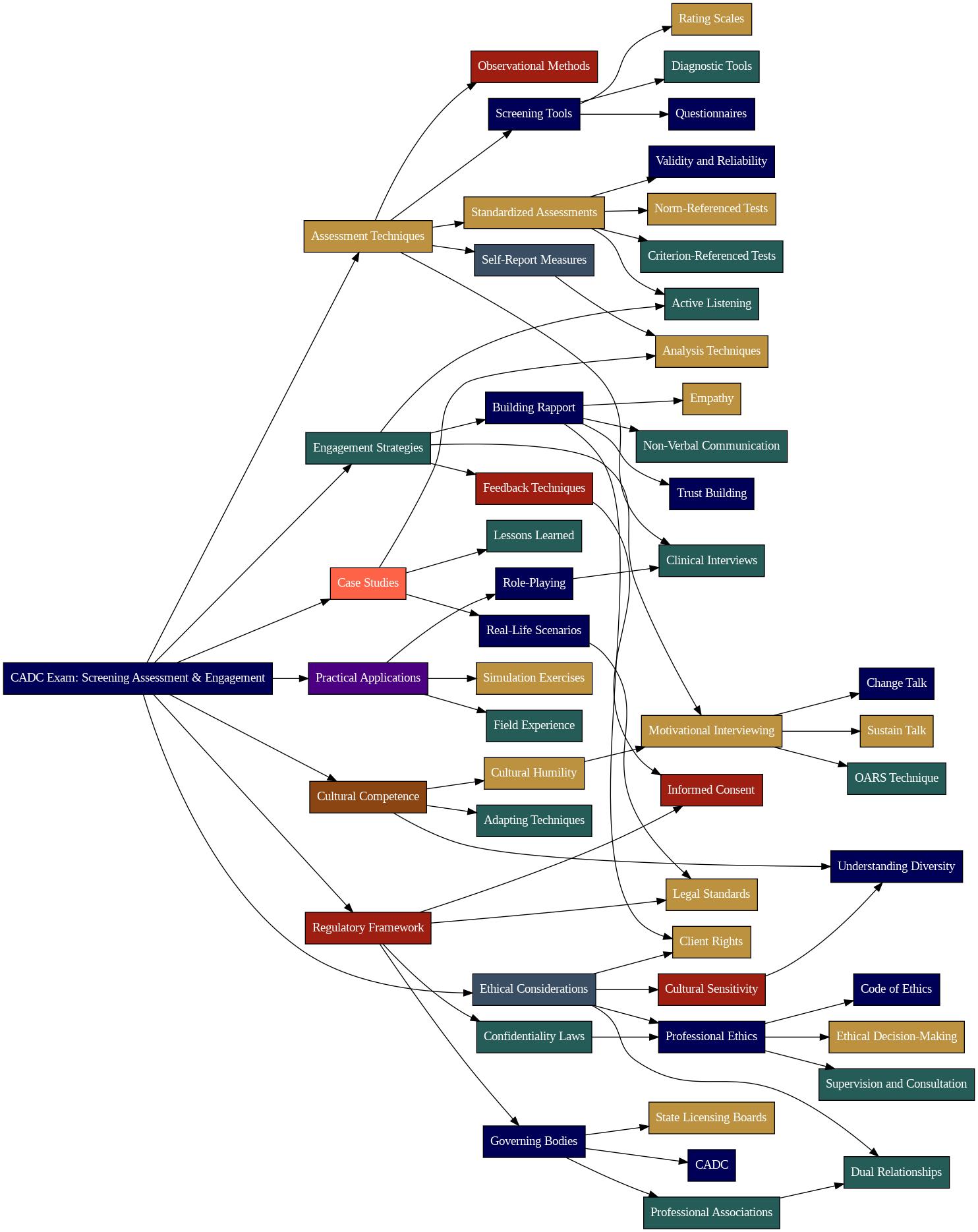
Quiz-summary
0 of 29 questions completed
Questions:
- 1
- 2
- 3
- 4
- 5
- 6
- 7
- 8
- 9
- 10
- 11
- 12
- 13
- 14
- 15
- 16
- 17
- 18
- 19
- 20
- 21
- 22
- 23
- 24
- 25
- 26
- 27
- 28
- 29
Information
Premium Practice Questions
You have already completed the quiz before. Hence you can not start it again.
Quiz is loading...
You must sign in or sign up to start the quiz.
You have to finish following quiz, to start this quiz:
Results
0 of 29 questions answered correctly
Your time:
Time has elapsed
Categories
- Not categorized 0%
- 1
- 2
- 3
- 4
- 5
- 6
- 7
- 8
- 9
- 10
- 11
- 12
- 13
- 14
- 15
- 16
- 17
- 18
- 19
- 20
- 21
- 22
- 23
- 24
- 25
- 26
- 27
- 28
- 29
- Answered
- Review
-
Question 1 of 29
1. Question
A Vermont LADC, working in an outpatient clinic, has a client named Elias who is mandated to treatment for driving under the influence. During a session, Elias casually mentions that his elderly neighbor, Ms. Albright, seems increasingly confused and has shown unexplained bruises in recent weeks. Elias suspects her caregiver, a distant relative, might be exploiting her financially and neglecting her medical needs. Ms. Albright has no children and Elias is her only friend. Under Vermont law, what is the LADC’s ethical and legal obligation in this situation?
Correct
In Vermont, Licensed Alcohol and Drug Counselors (LADCs) are mandated reporters under specific circumstances outlined in Vermont statutes concerning child abuse and neglect, as well as vulnerable adult abuse. The duty to report is triggered when the LADC has reasonable cause to believe that a child is abused or neglected, or that a vulnerable adult is being abused, neglected, or exploited. This reasonable cause is typically formed through direct observation, client disclosure, or information received from credible third parties. The LADC’s primary responsibility is to report these concerns to the Vermont Department for Children and Families (DCF) or the Vermont Adult Protective Services (APS), depending on whether the concern involves a child or a vulnerable adult. Failing to report suspected abuse or neglect can result in legal penalties and ethical sanctions for the LADC. The ethical decision-making process involves weighing the client’s confidentiality against the legal and ethical obligation to protect vulnerable individuals. This process often requires consultation with supervisors or legal counsel to ensure compliance with Vermont law and ethical standards. The LADC must document the reasons for their decision to report or not report, demonstrating a thoughtful and legally informed approach. The LADC must also understand the definitions of abuse, neglect, and exploitation as defined by Vermont law, as these definitions guide their reporting obligations.
Incorrect
In Vermont, Licensed Alcohol and Drug Counselors (LADCs) are mandated reporters under specific circumstances outlined in Vermont statutes concerning child abuse and neglect, as well as vulnerable adult abuse. The duty to report is triggered when the LADC has reasonable cause to believe that a child is abused or neglected, or that a vulnerable adult is being abused, neglected, or exploited. This reasonable cause is typically formed through direct observation, client disclosure, or information received from credible third parties. The LADC’s primary responsibility is to report these concerns to the Vermont Department for Children and Families (DCF) or the Vermont Adult Protective Services (APS), depending on whether the concern involves a child or a vulnerable adult. Failing to report suspected abuse or neglect can result in legal penalties and ethical sanctions for the LADC. The ethical decision-making process involves weighing the client’s confidentiality against the legal and ethical obligation to protect vulnerable individuals. This process often requires consultation with supervisors or legal counsel to ensure compliance with Vermont law and ethical standards. The LADC must document the reasons for their decision to report or not report, demonstrating a thoughtful and legally informed approach. The LADC must also understand the definitions of abuse, neglect, and exploitation as defined by Vermont law, as these definitions guide their reporting obligations.
-
Question 2 of 29
2. Question
A client, while in a counseling session with a Vermont LADC, expresses anger towards their former employer, stating, “I’m so mad, I could just go down there and do something stupid.” The client has a history of impulsive behavior, but no documented history of violence. The former employer is a large company with multiple employees. Considering the duty to warn and protect in Vermont, what is the MOST appropriate initial course of action for the LADC?
Correct
Vermont’s duty to warn laws, while not explicitly codified in the same manner as some other states, are derived from case law and professional ethical standards. A crucial element in determining the applicability of the duty to warn is whether a client poses an imminent threat of serious harm to a clearly identifiable victim or victims. “Imminent” implies that the threat is about to happen or is likely to happen very soon. “Serious harm” suggests significant physical or psychological damage. “Clearly identifiable” means the potential victim is specifically known, not a vague group or the general public. The LADC must also consider the client’s overall presentation, history of violence, access to means of harm, and any specific statements made regarding their intentions. Consultation with supervisors and legal counsel is paramount in navigating these complex situations. Failing to accurately assess the risk and take appropriate action could lead to legal repercussions and ethical violations. The LADC must document all steps taken in assessing and addressing the potential threat, including consultations and the rationale behind their decisions. The standard of care requires a reasonable and prudent professional to act in a similar situation.
Incorrect
Vermont’s duty to warn laws, while not explicitly codified in the same manner as some other states, are derived from case law and professional ethical standards. A crucial element in determining the applicability of the duty to warn is whether a client poses an imminent threat of serious harm to a clearly identifiable victim or victims. “Imminent” implies that the threat is about to happen or is likely to happen very soon. “Serious harm” suggests significant physical or psychological damage. “Clearly identifiable” means the potential victim is specifically known, not a vague group or the general public. The LADC must also consider the client’s overall presentation, history of violence, access to means of harm, and any specific statements made regarding their intentions. Consultation with supervisors and legal counsel is paramount in navigating these complex situations. Failing to accurately assess the risk and take appropriate action could lead to legal repercussions and ethical violations. The LADC must document all steps taken in assessing and addressing the potential threat, including consultations and the rationale behind their decisions. The standard of care requires a reasonable and prudent professional to act in a similar situation.
-
Question 3 of 29
3. Question
Jamal, a client in a Vermont outpatient substance use treatment program, discloses to his LADC, Anya, that he is having intense urges to relapse and, further, expresses anger towards his former business partner, stating, “I feel like going over there and teaching him a lesson he won’t forget.” Anya assesses that Jamal has a history of impulsive behavior when using substances but has never been physically violent. According to Vermont regulations and ethical guidelines for LADCs, what is Anya’s MOST appropriate initial course of action?
Correct
Vermont’s regulations regarding confidentiality for LADC’s align with federal guidelines (42 CFR Part 2) but also have state-specific nuances. If a client discloses intent to harm a specific individual, the LADC must navigate both federal and state laws. Vermont law generally supports the duty to warn, but it is not absolute and requires careful consideration of the immediacy and severity of the threat. Breaching confidentiality requires a clear and imminent danger, not just a vague concern. Consulting with a supervisor and documenting the decision-making process is crucial. Simply informing the client of the limits of confidentiality is not sufficient when there is a credible threat. Contacting law enforcement should be a last resort, after exploring other options to mitigate the risk, such as increasing the frequency of sessions or involving family support, if appropriate and with the client’s consent. The LADC must balance the client’s right to confidentiality with the duty to protect potential victims, adhering to the ethical guidelines of the profession and relevant Vermont statutes. The LADC’s actions should be guided by the principle of minimizing harm while respecting client autonomy as much as possible within the legal framework.
Incorrect
Vermont’s regulations regarding confidentiality for LADC’s align with federal guidelines (42 CFR Part 2) but also have state-specific nuances. If a client discloses intent to harm a specific individual, the LADC must navigate both federal and state laws. Vermont law generally supports the duty to warn, but it is not absolute and requires careful consideration of the immediacy and severity of the threat. Breaching confidentiality requires a clear and imminent danger, not just a vague concern. Consulting with a supervisor and documenting the decision-making process is crucial. Simply informing the client of the limits of confidentiality is not sufficient when there is a credible threat. Contacting law enforcement should be a last resort, after exploring other options to mitigate the risk, such as increasing the frequency of sessions or involving family support, if appropriate and with the client’s consent. The LADC must balance the client’s right to confidentiality with the duty to protect potential victims, adhering to the ethical guidelines of the profession and relevant Vermont statutes. The LADC’s actions should be guided by the principle of minimizing harm while respecting client autonomy as much as possible within the legal framework.
-
Question 4 of 29
4. Question
Which of the following approaches would be LEAST consistent with the principles of trauma-informed care in substance use counseling?
Correct
Trauma-informed care recognizes the widespread impact of trauma and aims to create a safe and supportive environment for clients. A key principle is avoiding re-traumatization, which means being mindful of practices that could trigger or exacerbate past trauma. Asking a client to repeatedly recount traumatic experiences in detail, without proper support and processing, can be re-traumatizing. Trauma-informed care emphasizes empowering clients, promoting safety, and fostering trust. It does not involve forcing clients to relive traumatic events.
Incorrect
Trauma-informed care recognizes the widespread impact of trauma and aims to create a safe and supportive environment for clients. A key principle is avoiding re-traumatization, which means being mindful of practices that could trigger or exacerbate past trauma. Asking a client to repeatedly recount traumatic experiences in detail, without proper support and processing, can be re-traumatizing. Trauma-informed care emphasizes empowering clients, promoting safety, and fostering trust. It does not involve forcing clients to relive traumatic events.
-
Question 5 of 29
5. Question
A Vermont LADC, working in an outpatient clinic, is counseling a client, Javier, who expresses anger towards his former supervisor, stating, “I’m so angry I could hurt him.” Javier has a history of verbal altercations but no documented history of physical violence. He refuses to disclose the supervisor’s name. Which of the following actions should the LADC prioritize *first*, according to Vermont’s ethical guidelines and legal requirements regarding duty to warn?
Correct
Vermont LADC counselors must navigate complex ethical landscapes. Duty to warn laws, as interpreted in Vermont, are triggered when a client poses a credible and imminent threat of serious physical harm to a clearly identified victim or victims. This is not simply about preventing any harm, but rather a specific, serious, and imminent danger. Counselors must carefully assess the credibility of the threat, the immediacy of the danger, and the identifiability of the potential victim(s). Consultation with supervisors and legal counsel is crucial in these situations to ensure adherence to both ethical guidelines and legal requirements. Confidentiality is paramount, but it’s not absolute; the safety of potential victims takes precedence when the criteria for duty to warn are met. Failure to act appropriately could result in legal liability and ethical sanctions. The counselor must document the assessment process, including the client’s statements, the counselor’s evaluation of the threat, and any actions taken. Furthermore, Vermont law and ethical guidelines emphasize the importance of considering cultural factors and individual circumstances when assessing risk and determining the appropriate course of action. This requires a nuanced understanding of the client’s background, beliefs, and potential motivations.
Incorrect
Vermont LADC counselors must navigate complex ethical landscapes. Duty to warn laws, as interpreted in Vermont, are triggered when a client poses a credible and imminent threat of serious physical harm to a clearly identified victim or victims. This is not simply about preventing any harm, but rather a specific, serious, and imminent danger. Counselors must carefully assess the credibility of the threat, the immediacy of the danger, and the identifiability of the potential victim(s). Consultation with supervisors and legal counsel is crucial in these situations to ensure adherence to both ethical guidelines and legal requirements. Confidentiality is paramount, but it’s not absolute; the safety of potential victims takes precedence when the criteria for duty to warn are met. Failure to act appropriately could result in legal liability and ethical sanctions. The counselor must document the assessment process, including the client’s statements, the counselor’s evaluation of the threat, and any actions taken. Furthermore, Vermont law and ethical guidelines emphasize the importance of considering cultural factors and individual circumstances when assessing risk and determining the appropriate course of action. This requires a nuanced understanding of the client’s background, beliefs, and potential motivations.
-
Question 6 of 29
6. Question
Kai, a Native American client in Vermont, is attending his first session with a Licensed Alcohol and Drug Counselor (LADC). During the session, Kai avoids making direct eye contact with the counselor. The counselor has been trained to use direct eye contact as a way to build rapport and demonstrate attentiveness. What is the MOST culturally competent response for the LADC in this situation?
Correct
Cultural competence is an essential aspect of ethical practice for LADCs in Vermont, requiring counselors to understand and respect the diverse cultural backgrounds of their clients. This includes recognizing the influence of culture on substance use patterns, treatment preferences, and help-seeking behaviors. It also involves adapting counseling approaches to be culturally sensitive and responsive to the client’s individual needs. The scenario highlights a situation where a Native American client, Kai, expresses discomfort with direct eye contact, a common counseling technique. Direct eye contact can be perceived as disrespectful or aggressive in some Native American cultures. A culturally competent LADC would recognize this cultural difference and adjust their communication style accordingly. Forcing Kai to maintain eye contact would be insensitive and potentially damaging to the therapeutic relationship. Ignoring Kai’s discomfort and continuing with the standard counseling approach would demonstrate a lack of cultural awareness. While psychoeducation about the benefits of eye contact may be appropriate in some contexts, it is not the priority in this situation. The most culturally sensitive approach is to respect Kai’s preferences and adapt the counseling style to accommodate his cultural background, while still maintaining effective communication.
Incorrect
Cultural competence is an essential aspect of ethical practice for LADCs in Vermont, requiring counselors to understand and respect the diverse cultural backgrounds of their clients. This includes recognizing the influence of culture on substance use patterns, treatment preferences, and help-seeking behaviors. It also involves adapting counseling approaches to be culturally sensitive and responsive to the client’s individual needs. The scenario highlights a situation where a Native American client, Kai, expresses discomfort with direct eye contact, a common counseling technique. Direct eye contact can be perceived as disrespectful or aggressive in some Native American cultures. A culturally competent LADC would recognize this cultural difference and adjust their communication style accordingly. Forcing Kai to maintain eye contact would be insensitive and potentially damaging to the therapeutic relationship. Ignoring Kai’s discomfort and continuing with the standard counseling approach would demonstrate a lack of cultural awareness. While psychoeducation about the benefits of eye contact may be appropriate in some contexts, it is not the priority in this situation. The most culturally sensitive approach is to respect Kai’s preferences and adapt the counseling style to accommodate his cultural background, while still maintaining effective communication.
-
Question 7 of 29
7. Question
Under what specific circumstance is a Vermont Licensed Alcohol and Drug Counselor (LADC) legally PERMITTED to breach client confidentiality?
Correct
Vermont’s regulations concerning client confidentiality for LADCs are stringent, but they are not absolute. While protecting client information is paramount, there are specific exceptions where disclosure is permitted or even mandated by law. One such exception is when a client presents an imminent threat of harm to themselves or others. This “duty to warn and protect” doctrine, stemming from the Tarasoff case, allows (and sometimes requires) a therapist to breach confidentiality to take reasonable steps to prevent the threatened harm. These steps might include notifying the potential victim, contacting law enforcement, or initiating involuntary commitment proceedings. It’s crucial to note that this exception is narrowly construed and applies only when there is a credible and imminent threat. General concerns about a client’s behavior or past history are not sufficient grounds for breaching confidentiality. A court order compelling disclosure is another exception, as is obtaining the client’s written consent to release information.
Incorrect
Vermont’s regulations concerning client confidentiality for LADCs are stringent, but they are not absolute. While protecting client information is paramount, there are specific exceptions where disclosure is permitted or even mandated by law. One such exception is when a client presents an imminent threat of harm to themselves or others. This “duty to warn and protect” doctrine, stemming from the Tarasoff case, allows (and sometimes requires) a therapist to breach confidentiality to take reasonable steps to prevent the threatened harm. These steps might include notifying the potential victim, contacting law enforcement, or initiating involuntary commitment proceedings. It’s crucial to note that this exception is narrowly construed and applies only when there is a credible and imminent threat. General concerns about a client’s behavior or past history are not sufficient grounds for breaching confidentiality. A court order compelling disclosure is another exception, as is obtaining the client’s written consent to release information.
-
Question 8 of 29
8. Question
Jamal, a client in substance use treatment with a Vermont LADC, expresses anger towards his estranged wife, Aisha, during a counseling session. He states, “I’m so angry I could strangle her,” but immediately adds, “I would never actually do that, I just need to vent.” Aisha lives in Burlington, VT. What is the MOST ETHICALLY sound course of action for the LADC, considering Vermont laws and ethical guidelines?
Correct
In Vermont, Licensed Alcohol and Drug Counselors (LADCs) are legally and ethically bound to uphold client confidentiality, as stipulated by both state laws and professional ethical codes. This principle is not absolute and is subject to specific exceptions outlined in Vermont statutes and federal regulations, particularly concerning duty to warn and protect. The “duty to warn and protect,” stemming from the Tarasoff ruling, requires counselors to take reasonable steps to protect a third party from a client’s serious threat of harm. This duty supersedes confidentiality when a client poses an imminent danger to an identifiable victim. Vermont law aligns with this principle, mandating that LADCs report credible threats of violence to potential victims and law enforcement. However, the counselor must exercise professional judgment, considering the credibility of the threat, the client’s intent, and the potential for harm. Furthermore, Vermont’s mandatory reporting laws necessitate reporting suspected child abuse or neglect, even if it means breaching client confidentiality. The LADC must adhere to the specific reporting procedures outlined in Vermont’s child protection statutes, ensuring the report is made to the appropriate authorities within the mandated timeframe. Failure to comply with these legal and ethical obligations can result in disciplinary action by the Vermont Board of Allied Mental Health Practitioners, including suspension or revocation of licensure, as well as potential civil or criminal liability. The counselor must carefully document the decision-making process when considering breaching confidentiality, including the rationale for the action taken and any consultations with supervisors or legal counsel.
Incorrect
In Vermont, Licensed Alcohol and Drug Counselors (LADCs) are legally and ethically bound to uphold client confidentiality, as stipulated by both state laws and professional ethical codes. This principle is not absolute and is subject to specific exceptions outlined in Vermont statutes and federal regulations, particularly concerning duty to warn and protect. The “duty to warn and protect,” stemming from the Tarasoff ruling, requires counselors to take reasonable steps to protect a third party from a client’s serious threat of harm. This duty supersedes confidentiality when a client poses an imminent danger to an identifiable victim. Vermont law aligns with this principle, mandating that LADCs report credible threats of violence to potential victims and law enforcement. However, the counselor must exercise professional judgment, considering the credibility of the threat, the client’s intent, and the potential for harm. Furthermore, Vermont’s mandatory reporting laws necessitate reporting suspected child abuse or neglect, even if it means breaching client confidentiality. The LADC must adhere to the specific reporting procedures outlined in Vermont’s child protection statutes, ensuring the report is made to the appropriate authorities within the mandated timeframe. Failure to comply with these legal and ethical obligations can result in disciplinary action by the Vermont Board of Allied Mental Health Practitioners, including suspension or revocation of licensure, as well as potential civil or criminal liability. The counselor must carefully document the decision-making process when considering breaching confidentiality, including the rationale for the action taken and any consultations with supervisors or legal counsel.
-
Question 9 of 29
9. Question
Sixteen-year-old Kai, residing in Vermont, independently seeks substance abuse counseling from a Licensed Alcohol and Drug Counselor (LADC) without informing their parents. Kai expresses fear that parental involvement would lead to being kicked out of the house and discontinuing school. Under Vermont statutes and ethical guidelines for LADCs, what is the MOST appropriate initial course of action for the counselor?
Correct
Vermont LADC professionals must adhere to strict guidelines regarding client confidentiality, particularly concerning minors. Vermont law and ethical standards prioritize the well-being of the minor while balancing parental rights. In situations where a minor seeks substance abuse treatment without parental consent, Vermont statutes, guided by principles of client autonomy and the potential for harm reduction, allow for certain exceptions to standard confidentiality practices. If the LADC assesses that the minor is knowingly and voluntarily seeking treatment, is mature enough to participate effectively, and that involving the parents would be detrimental to the minor’s treatment or well-being (e.g., due to potential abuse, neglect, or rejection), the counselor may proceed with treatment while upholding the minor’s confidentiality. However, this decision must be carefully documented, considering the potential legal and ethical ramifications. Consultation with supervisors and legal counsel is highly recommended in such cases to ensure compliance with all applicable laws and regulations. The key principle is to act in the best interest of the minor, prioritizing their safety and well-being while respecting their developing autonomy. This involves a careful assessment of the minor’s capacity for informed consent and the potential risks and benefits of involving parents.
Incorrect
Vermont LADC professionals must adhere to strict guidelines regarding client confidentiality, particularly concerning minors. Vermont law and ethical standards prioritize the well-being of the minor while balancing parental rights. In situations where a minor seeks substance abuse treatment without parental consent, Vermont statutes, guided by principles of client autonomy and the potential for harm reduction, allow for certain exceptions to standard confidentiality practices. If the LADC assesses that the minor is knowingly and voluntarily seeking treatment, is mature enough to participate effectively, and that involving the parents would be detrimental to the minor’s treatment or well-being (e.g., due to potential abuse, neglect, or rejection), the counselor may proceed with treatment while upholding the minor’s confidentiality. However, this decision must be carefully documented, considering the potential legal and ethical ramifications. Consultation with supervisors and legal counsel is highly recommended in such cases to ensure compliance with all applicable laws and regulations. The key principle is to act in the best interest of the minor, prioritizing their safety and well-being while respecting their developing autonomy. This involves a careful assessment of the minor’s capacity for informed consent and the potential risks and benefits of involving parents.
-
Question 10 of 29
10. Question
A Vermont LADC, working with a client diagnosed with both opioid use disorder and severe depression, learns that the client has expressed a detailed plan to harm a specific former partner due to perceived betrayal. The client has a history of violent behavior when using substances. According to Vermont’s ethical guidelines and legal obligations concerning duty to protect, what is the MOST appropriate course of action for the LADC?
Correct
In Vermont, Licensed Alcohol and Drug Counselors (LADCs) face unique ethical challenges when working with clients who have co-occurring substance use and mental health disorders, especially concerning confidentiality and duty to protect. Vermont’s specific regulations, aligned with both state and federal guidelines (like HIPAA and 42 CFR Part 2), necessitate a nuanced approach. When a client presents a serious and imminent threat to an identifiable third party, the LADC must balance the client’s right to confidentiality with the duty to protect the potential victim. This requires careful consideration of the severity of the threat, the likelihood of its occurrence, and the identifiability of the potential victim. Vermont statutes dictate that in such situations, the LADC may be required to disclose confidential information to law enforcement or the potential victim to prevent harm. However, this disclosure must be limited to the information necessary to prevent the threatened harm and must be documented thoroughly. The LADC should also consult with supervisors and legal counsel to ensure compliance with ethical and legal standards. Failing to act appropriately could result in legal liability and disciplinary action from the licensing board. Furthermore, the LADC should consider the impact of disclosure on the therapeutic relationship and explore alternative interventions, such as increasing the intensity of treatment or involving family members, before breaching confidentiality. The key is to prioritize the safety of the potential victim while respecting the client’s rights to the greatest extent possible under Vermont law and ethical guidelines.
Incorrect
In Vermont, Licensed Alcohol and Drug Counselors (LADCs) face unique ethical challenges when working with clients who have co-occurring substance use and mental health disorders, especially concerning confidentiality and duty to protect. Vermont’s specific regulations, aligned with both state and federal guidelines (like HIPAA and 42 CFR Part 2), necessitate a nuanced approach. When a client presents a serious and imminent threat to an identifiable third party, the LADC must balance the client’s right to confidentiality with the duty to protect the potential victim. This requires careful consideration of the severity of the threat, the likelihood of its occurrence, and the identifiability of the potential victim. Vermont statutes dictate that in such situations, the LADC may be required to disclose confidential information to law enforcement or the potential victim to prevent harm. However, this disclosure must be limited to the information necessary to prevent the threatened harm and must be documented thoroughly. The LADC should also consult with supervisors and legal counsel to ensure compliance with ethical and legal standards. Failing to act appropriately could result in legal liability and disciplinary action from the licensing board. Furthermore, the LADC should consider the impact of disclosure on the therapeutic relationship and explore alternative interventions, such as increasing the intensity of treatment or involving family members, before breaching confidentiality. The key is to prioritize the safety of the potential victim while respecting the client’s rights to the greatest extent possible under Vermont law and ethical guidelines.
-
Question 11 of 29
11. Question
Aisha, a client seeking treatment in Vermont, exhibits the following behaviors related to her substance use: she often takes larger amounts of the substance than she intends, she experiences intense cravings, she has failed to fulfill obligations at work due to her substance use, and she continues to use the substance despite knowing it negatively impacts her relationships. According to the DSM-5 criteria, what is the severity of Aisha’s Substance Use Disorder?
Correct
The DSM-5 (Diagnostic and Statistical Manual of Mental Disorders, 5th Edition) provides specific criteria for diagnosing Substance Use Disorders (SUDs). These criteria are organized into categories reflecting impaired control, social impairment, risky use, and pharmacological criteria (tolerance and withdrawal). The severity of the SUD is determined by the number of criteria met: 2-3 criteria indicate a mild SUD, 4-5 indicate a moderate SUD, and 6 or more indicate a severe SUD. In this scenario, Aisha meets four of the DSM-5 criteria: taking larger amounts than intended (impaired control), craving (impaired control), failing to fulfill obligations (social impairment), and continuing use despite negative consequences (risky use). Since she meets four criteria, her SUD would be classified as moderate. Understanding the DSM-5 criteria and severity classifications is essential for accurate diagnosis and treatment planning in substance use counseling.
Incorrect
The DSM-5 (Diagnostic and Statistical Manual of Mental Disorders, 5th Edition) provides specific criteria for diagnosing Substance Use Disorders (SUDs). These criteria are organized into categories reflecting impaired control, social impairment, risky use, and pharmacological criteria (tolerance and withdrawal). The severity of the SUD is determined by the number of criteria met: 2-3 criteria indicate a mild SUD, 4-5 indicate a moderate SUD, and 6 or more indicate a severe SUD. In this scenario, Aisha meets four of the DSM-5 criteria: taking larger amounts than intended (impaired control), craving (impaired control), failing to fulfill obligations (social impairment), and continuing use despite negative consequences (risky use). Since she meets four criteria, her SUD would be classified as moderate. Understanding the DSM-5 criteria and severity classifications is essential for accurate diagnosis and treatment planning in substance use counseling.
-
Question 12 of 29
12. Question
A Vermont LADC, Benicio, is working with a client, Anya, who discloses a detailed plan to harm her estranged business partner due to a financial dispute. Anya has a history of impulsive behavior and owns several firearms. Which of the following actions BEST reflects the LADC’s ethical and legal obligations in this situation, considering Vermont-specific guidelines?
Correct
In Vermont, an LADC’s duty to warn and protect comes into play when a client presents a serious and imminent threat of harm to a reasonably identifiable victim. This duty, while rooted in the Tarasoff decision, is further defined by Vermont state law and ethical guidelines for licensed professionals. The LADC must assess the credibility and immediacy of the threat, considering factors such as the client’s history of violence, access to means of harm, and the specificity of the threat. If the threat is deemed credible and imminent, the LADC is ethically and legally obligated to take reasonable steps to protect the intended victim. These steps may include notifying the potential victim, contacting law enforcement, or initiating involuntary commitment proceedings if the client meets the criteria for such action under Vermont’s mental health laws. The LADC’s actions must be carefully documented, demonstrating a thorough assessment of the threat and the rationale for the chosen course of action. Consultation with supervisors or legal counsel is highly recommended to ensure compliance with ethical and legal standards. The LADC must also consider the impact of breaching confidentiality on the therapeutic relationship and explore alternative interventions if possible, while prioritizing the safety of the potential victim. The specific requirements for duty to warn in Vermont necessitate a careful balancing act between client confidentiality and the protection of potential victims, guided by legal and ethical mandates.
Incorrect
In Vermont, an LADC’s duty to warn and protect comes into play when a client presents a serious and imminent threat of harm to a reasonably identifiable victim. This duty, while rooted in the Tarasoff decision, is further defined by Vermont state law and ethical guidelines for licensed professionals. The LADC must assess the credibility and immediacy of the threat, considering factors such as the client’s history of violence, access to means of harm, and the specificity of the threat. If the threat is deemed credible and imminent, the LADC is ethically and legally obligated to take reasonable steps to protect the intended victim. These steps may include notifying the potential victim, contacting law enforcement, or initiating involuntary commitment proceedings if the client meets the criteria for such action under Vermont’s mental health laws. The LADC’s actions must be carefully documented, demonstrating a thorough assessment of the threat and the rationale for the chosen course of action. Consultation with supervisors or legal counsel is highly recommended to ensure compliance with ethical and legal standards. The LADC must also consider the impact of breaching confidentiality on the therapeutic relationship and explore alternative interventions if possible, while prioritizing the safety of the potential victim. The specific requirements for duty to warn in Vermont necessitate a careful balancing act between client confidentiality and the protection of potential victims, guided by legal and ethical mandates.
-
Question 13 of 29
13. Question
A 16-year-old client, Maria, seeks substance use counseling from a Vermont LADC. Maria fears that if her parents are informed, they will react negatively, potentially leading to her being kicked out of the house and discontinuing her education. Based on Vermont statutes regarding confidentiality and minors seeking substance use treatment, what is the MOST ethically sound course of action for the LADC?
Correct
Vermont LADC professionals are bound by specific ethical guidelines concerning client confidentiality, particularly regarding minors seeking substance use treatment. While parental consent is generally required for minors to receive medical treatment, Vermont law provides exceptions to protect the minor’s autonomy and well-being, especially in sensitive situations like substance use treatment. The key principle here is balancing the minor’s right to privacy and access to care with the parent’s right to be informed and involved. The Vermont Statutes Title 18, § 4233, addresses confidentiality for minors seeking mental health and substance use services. This statute permits a minor to consent to outpatient mental health services if the professional determines the minor is mature enough to participate intelligently in the services and if parental notification would be detrimental to the minor’s care. This statute does not explicitly state an age, but implies that the professional must assess the minor’s maturity level. The counselor should document the rationale for not involving the parents, including the potential harm to the minor if parental notification occurs. It is also important to consider that if the minor is at risk of harm to self or others, duty to warn and protect may override confidentiality. The LADC should consult with a supervisor or legal counsel if uncertain about the best course of action.
Incorrect
Vermont LADC professionals are bound by specific ethical guidelines concerning client confidentiality, particularly regarding minors seeking substance use treatment. While parental consent is generally required for minors to receive medical treatment, Vermont law provides exceptions to protect the minor’s autonomy and well-being, especially in sensitive situations like substance use treatment. The key principle here is balancing the minor’s right to privacy and access to care with the parent’s right to be informed and involved. The Vermont Statutes Title 18, § 4233, addresses confidentiality for minors seeking mental health and substance use services. This statute permits a minor to consent to outpatient mental health services if the professional determines the minor is mature enough to participate intelligently in the services and if parental notification would be detrimental to the minor’s care. This statute does not explicitly state an age, but implies that the professional must assess the minor’s maturity level. The counselor should document the rationale for not involving the parents, including the potential harm to the minor if parental notification occurs. It is also important to consider that if the minor is at risk of harm to self or others, duty to warn and protect may override confidentiality. The LADC should consult with a supervisor or legal counsel if uncertain about the best course of action.
-
Question 14 of 29
14. Question
During a session, a client, Omar, states, “I know I should probably cut back on drinking, but it’s the only way I can relax after work.” Which Motivational Interviewing (MI) technique would be MOST effective in addressing Omar’s ambivalence in this scenario?
Correct
Motivational Interviewing (MI) is a client-centered, directive counseling style designed to enhance intrinsic motivation for change by exploring and resolving ambivalence. Key principles of MI include expressing empathy, developing discrepancy, avoiding argumentation, rolling with resistance, and supporting self-efficacy. Open-ended questions are used to elicit the client’s own perspectives and experiences, rather than imposing the counselor’s views. Affirmations are used to recognize and validate the client’s strengths and efforts. Reflective listening is used to understand and reflect back the client’s feelings and thoughts. Summaries are used to reinforce what the client has said and to ensure mutual understanding. MI is particularly effective in the early stages of change, such as Precontemplation and Contemplation, where individuals may be resistant or ambivalent about changing their behavior. The goal is to help individuals move from being unaware or unsure about their substance use to becoming more motivated and committed to change. Developing discrepancy involves helping the client to see the inconsistencies between their current behavior and their values or goals. This can be done by exploring the pros and cons of their substance use and the potential benefits of changing their behavior.
Incorrect
Motivational Interviewing (MI) is a client-centered, directive counseling style designed to enhance intrinsic motivation for change by exploring and resolving ambivalence. Key principles of MI include expressing empathy, developing discrepancy, avoiding argumentation, rolling with resistance, and supporting self-efficacy. Open-ended questions are used to elicit the client’s own perspectives and experiences, rather than imposing the counselor’s views. Affirmations are used to recognize and validate the client’s strengths and efforts. Reflective listening is used to understand and reflect back the client’s feelings and thoughts. Summaries are used to reinforce what the client has said and to ensure mutual understanding. MI is particularly effective in the early stages of change, such as Precontemplation and Contemplation, where individuals may be resistant or ambivalent about changing their behavior. The goal is to help individuals move from being unaware or unsure about their substance use to becoming more motivated and committed to change. Developing discrepancy involves helping the client to see the inconsistencies between their current behavior and their values or goals. This can be done by exploring the pros and cons of their substance use and the potential benefits of changing their behavior.
-
Question 15 of 29
15. Question
A client in Vermont, receiving counseling from an LADC for alcohol use disorder, also expresses symptoms of severe depression and anxiety. Which of the following actions is MOST appropriate for the LADC to take, considering their scope of practice?
Correct
Scope of practice for an LADC in Vermont is defined by state regulations and professional ethical guidelines. It outlines the specific activities and services that an LADC is legally and ethically permitted to perform. Generally, the scope of practice includes assessment, diagnosis, treatment planning, individual and group counseling, relapse prevention, and referral services related to substance use disorders. LADCs must practice within the boundaries of their competence and training, and they must not provide services that require a higher level of licensure or expertise (e.g., prescribing medication, providing psychotherapy for mental health disorders outside the scope of substance use). Understanding the scope of practice is essential for protecting client welfare and avoiding legal and ethical violations.
Incorrect
Scope of practice for an LADC in Vermont is defined by state regulations and professional ethical guidelines. It outlines the specific activities and services that an LADC is legally and ethically permitted to perform. Generally, the scope of practice includes assessment, diagnosis, treatment planning, individual and group counseling, relapse prevention, and referral services related to substance use disorders. LADCs must practice within the boundaries of their competence and training, and they must not provide services that require a higher level of licensure or expertise (e.g., prescribing medication, providing psychotherapy for mental health disorders outside the scope of substance use). Understanding the scope of practice is essential for protecting client welfare and avoiding legal and ethical violations.
-
Question 16 of 29
16. Question
LADC Raj, practicing in a small, rural town in Vermont, discovers that a new client, Sarah, is also a member of the same small Alcoholics Anonymous (AA) group that Raj attends regularly. Raj is concerned about the potential for a dual relationship. What is Raj’s *most* ethically sound course of action?
Correct
Vermont LADCs must adhere to strict professional boundaries to maintain the integrity of the therapeutic relationship and prevent exploitation of clients. Dual relationships, where the counselor has another relationship with the client (e.g., business, social, or sexual), are generally unethical and should be avoided. Exceptions may occur in small, rural communities, but these situations require careful consideration, consultation, and documentation to minimize potential harm. The power differential inherent in the counselor-client relationship makes it difficult for clients to give truly voluntary consent to a dual relationship.
Incorrect
Vermont LADCs must adhere to strict professional boundaries to maintain the integrity of the therapeutic relationship and prevent exploitation of clients. Dual relationships, where the counselor has another relationship with the client (e.g., business, social, or sexual), are generally unethical and should be avoided. Exceptions may occur in small, rural communities, but these situations require careful consideration, consultation, and documentation to minimize potential harm. The power differential inherent in the counselor-client relationship makes it difficult for clients to give truly voluntary consent to a dual relationship.
-
Question 17 of 29
17. Question
According to Vermont regulations, what is the PRIMARY purpose of continuing education requirements for Licensed Alcohol and Drug Counselors (LADCs)?
Correct
Vermont’s regulations for LADCs emphasize the importance of continuing education to maintain competence and stay current with best practices in the field. LADCs are required to complete a certain number of continuing education hours per renewal period, with specific requirements for ethics and other relevant topics. The purpose of continuing education is to enhance the LADC’s knowledge, skills, and abilities, and to promote ethical and professional conduct. Acceptable continuing education activities include workshops, seminars, conferences, academic courses, and self-study programs that are relevant to the practice of alcohol and drug counseling. LADCs are responsible for maintaining documentation of their continuing education activities and for ensuring that they meet the requirements for license renewal. Failure to comply with continuing education requirements can result in disciplinary action.
Incorrect
Vermont’s regulations for LADCs emphasize the importance of continuing education to maintain competence and stay current with best practices in the field. LADCs are required to complete a certain number of continuing education hours per renewal period, with specific requirements for ethics and other relevant topics. The purpose of continuing education is to enhance the LADC’s knowledge, skills, and abilities, and to promote ethical and professional conduct. Acceptable continuing education activities include workshops, seminars, conferences, academic courses, and self-study programs that are relevant to the practice of alcohol and drug counseling. LADCs are responsible for maintaining documentation of their continuing education activities and for ensuring that they meet the requirements for license renewal. Failure to comply with continuing education requirements can result in disciplinary action.
-
Question 18 of 29
18. Question
A Vermont LADC is working with a new client who is a recent immigrant from a culture where open discussion of personal problems with strangers is highly stigmatized. The client appears hesitant to share details about their substance use and related challenges. What is the MOST culturally competent approach for the LADC to take in this situation?
Correct
Cultural competence in substance use counseling involves understanding and respecting the diverse cultural backgrounds of clients. It requires counselors to be aware of their own cultural biases and assumptions, as well as the cultural values, beliefs, and practices of their clients. Cultural competence also includes adapting counseling approaches to meet the specific needs of clients from different cultural groups. This may involve using culturally appropriate language, incorporating traditional healing practices, or involving family members in the treatment process. Vermont’s ethical guidelines for LADCs emphasize the importance of cultural competence in providing effective and ethical services. Counselors must seek ongoing training and education to enhance their cultural competence and address disparities in access to and outcomes of substance use treatment. Failure to provide culturally competent services can lead to misdiagnosis, ineffective treatment, and harm to clients. In this scenario, the LADC is working with a client from a different cultural background who is hesitant to disclose personal information. The LADC should recognize that this hesitancy may be related to cultural norms around privacy and disclosure. The LADC should build trust with the client by demonstrating respect for their cultural background and adapting their counseling approach accordingly.
Incorrect
Cultural competence in substance use counseling involves understanding and respecting the diverse cultural backgrounds of clients. It requires counselors to be aware of their own cultural biases and assumptions, as well as the cultural values, beliefs, and practices of their clients. Cultural competence also includes adapting counseling approaches to meet the specific needs of clients from different cultural groups. This may involve using culturally appropriate language, incorporating traditional healing practices, or involving family members in the treatment process. Vermont’s ethical guidelines for LADCs emphasize the importance of cultural competence in providing effective and ethical services. Counselors must seek ongoing training and education to enhance their cultural competence and address disparities in access to and outcomes of substance use treatment. Failure to provide culturally competent services can lead to misdiagnosis, ineffective treatment, and harm to clients. In this scenario, the LADC is working with a client from a different cultural background who is hesitant to disclose personal information. The LADC should recognize that this hesitancy may be related to cultural norms around privacy and disclosure. The LADC should build trust with the client by demonstrating respect for their cultural background and adapting their counseling approach accordingly.
-
Question 19 of 29
19. Question
According to the DSM-5 criteria, what is the MINIMUM number of criteria that must be met within a 12-month period to qualify for a diagnosis of a substance use disorder?
Correct
The DSM-5 (Diagnostic and Statistical Manual of Mental Disorders, 5th Edition) provides specific diagnostic criteria for substance use disorders. These criteria are organized into categories such as impaired control, social impairment, risky use, and pharmacological criteria (tolerance and withdrawal). A diagnosis of a substance use disorder requires the presence of a specific number of criteria within a 12-month period. The severity of the disorder (mild, moderate, or severe) is determined by the number of criteria met. The DSM-5 emphasizes a dimensional approach, recognizing that substance use disorders exist on a spectrum of severity. It’s crucial for LADCs to accurately apply these criteria to ensure appropriate diagnosis and treatment planning. The DSM-5 also includes specifiers to indicate the specific substance involved and the course of the disorder (e.g., in early remission, in sustained remission).
Incorrect
The DSM-5 (Diagnostic and Statistical Manual of Mental Disorders, 5th Edition) provides specific diagnostic criteria for substance use disorders. These criteria are organized into categories such as impaired control, social impairment, risky use, and pharmacological criteria (tolerance and withdrawal). A diagnosis of a substance use disorder requires the presence of a specific number of criteria within a 12-month period. The severity of the disorder (mild, moderate, or severe) is determined by the number of criteria met. The DSM-5 emphasizes a dimensional approach, recognizing that substance use disorders exist on a spectrum of severity. It’s crucial for LADCs to accurately apply these criteria to ensure appropriate diagnosis and treatment planning. The DSM-5 also includes specifiers to indicate the specific substance involved and the course of the disorder (e.g., in early remission, in sustained remission).
-
Question 20 of 29
20. Question
Jamal, a client in a Vermont outpatient substance use treatment program, discloses to his LADC counselor, Anya, that he is experiencing intense anger towards his former supervisor, Ben. Jamal states, “I’m so angry, I could just explode! He ruined my career.” While Jamal expresses these feelings, he also states, “I would never actually hurt anyone, but I fantasize about it.” Anya’s assessment reveals no prior history of violence, but Jamal’s anger seems unusually intense. Considering the ethical and legal considerations for a Vermont LADC, what is Anya’s MOST appropriate course of action?
Correct
Vermont LADC counselors must prioritize client safety and adhere to legal and ethical guidelines, especially when dealing with potential harm to self or others. The Tarasoff ruling and subsequent interpretations in Vermont (though Vermont doesn’t have a specific Tarasoff law, the principle of Duty to Warn is still applicable through ethical standards and common law) mandate a duty to protect when a client poses a credible threat. This involves assessing the immediacy and severity of the threat, identifying the potential victim, and taking reasonable steps to prevent harm. This often involves informing the potential victim and/or law enforcement, even if it means breaching confidentiality. Documenting the assessment, decision-making process, and actions taken is crucial for legal and ethical protection. Consultation with supervisors and legal counsel is highly recommended in such situations to ensure the appropriate course of action is taken. The counselor’s primary responsibility is to mitigate harm while adhering to ethical guidelines to the greatest extent possible. Failing to act appropriately could result in legal repercussions and ethical violations. The severity of the threat and the specificity of the potential victim are key factors in determining the appropriate response.
Incorrect
Vermont LADC counselors must prioritize client safety and adhere to legal and ethical guidelines, especially when dealing with potential harm to self or others. The Tarasoff ruling and subsequent interpretations in Vermont (though Vermont doesn’t have a specific Tarasoff law, the principle of Duty to Warn is still applicable through ethical standards and common law) mandate a duty to protect when a client poses a credible threat. This involves assessing the immediacy and severity of the threat, identifying the potential victim, and taking reasonable steps to prevent harm. This often involves informing the potential victim and/or law enforcement, even if it means breaching confidentiality. Documenting the assessment, decision-making process, and actions taken is crucial for legal and ethical protection. Consultation with supervisors and legal counsel is highly recommended in such situations to ensure the appropriate course of action is taken. The counselor’s primary responsibility is to mitigate harm while adhering to ethical guidelines to the greatest extent possible. Failing to act appropriately could result in legal repercussions and ethical violations. The severity of the threat and the specificity of the potential victim are key factors in determining the appropriate response.
-
Question 21 of 29
21. Question
An LADC in Vermont is working with a client, Benicio, who has a history of aggressive behavior. During a session, Benicio reveals a detailed plan to physically harm his ex-partner, Isabella, including specific times and locations. Benicio has the means to carry out this threat. According to Vermont’s ethical and legal standards for LADCs, what is the MOST appropriate course of action?
Correct
Vermont’s regulations regarding client confidentiality are stringent, reflecting the ethical principles of the LADC profession and the legal requirements outlined in both state and federal laws. When a client discloses intent to harm a specific individual, the LADC faces a critical ethical and legal dilemma. Vermont law aligns with the duty to warn and protect, requiring the counselor to take reasonable steps to protect the intended victim from harm. This duty overrides the general principle of confidentiality. Reasonable steps typically include assessing the credibility and immediacy of the threat, contacting the intended victim if possible, and notifying law enforcement. Documenting all actions taken, consultations sought, and the rationale behind the decisions is crucial for legal and ethical defensibility. Consulting with supervisors or legal counsel is highly recommended in such situations to ensure compliance with all applicable laws and ethical standards. Ignoring the threat or solely relying on the client’s assurances would be a violation of the duty to protect. Seeking a court order might be necessary in complex situations, but immediate action is usually required to prevent potential harm. The LADC must balance client confidentiality with the responsibility to protect potential victims, adhering to the specific guidelines and legal framework in Vermont.
Incorrect
Vermont’s regulations regarding client confidentiality are stringent, reflecting the ethical principles of the LADC profession and the legal requirements outlined in both state and federal laws. When a client discloses intent to harm a specific individual, the LADC faces a critical ethical and legal dilemma. Vermont law aligns with the duty to warn and protect, requiring the counselor to take reasonable steps to protect the intended victim from harm. This duty overrides the general principle of confidentiality. Reasonable steps typically include assessing the credibility and immediacy of the threat, contacting the intended victim if possible, and notifying law enforcement. Documenting all actions taken, consultations sought, and the rationale behind the decisions is crucial for legal and ethical defensibility. Consulting with supervisors or legal counsel is highly recommended in such situations to ensure compliance with all applicable laws and ethical standards. Ignoring the threat or solely relying on the client’s assurances would be a violation of the duty to protect. Seeking a court order might be necessary in complex situations, but immediate action is usually required to prevent potential harm. The LADC must balance client confidentiality with the responsibility to protect potential victims, adhering to the specific guidelines and legal framework in Vermont.
-
Question 22 of 29
22. Question
An LADC in Vermont is working with a client, Kai, who discloses a detailed plan to harm a specific individual, their former supervisor, due to perceived professional sabotage. Kai has a history of impulsive behavior and owns several firearms. According to Vermont’s ethical guidelines and legal obligations for LADCs, what is the MOST appropriate initial course of action?
Correct
Vermont’s ethical guidelines for LADCs, informed by both state regulations and broader ethical principles, prioritize client well-being and autonomy. In situations where a client presents a clear and imminent risk to an identifiable third party, the LADC’s duty to protect supersedes confidentiality. This duty is not absolute; it requires careful assessment of the threat’s credibility, the client’s intent, and the potential consequences of both action and inaction. Consultation with supervisors, legal counsel, and other professionals is crucial in navigating these complex situations. The specific steps an LADC must take are outlined in Vermont’s licensing regulations and professional ethical codes, which generally include attempting to persuade the client to take responsible action, notifying the potential victim, and contacting law enforcement if necessary. The decision-making process must be thoroughly documented to demonstrate the LADC’s adherence to ethical and legal standards. The LADC must also consider the potential impact on the therapeutic relationship and the client’s willingness to engage in treatment. Furthermore, the LADC should consider the cultural context of the situation and the client’s background, as these factors may influence the assessment of risk and the appropriate course of action. The ultimate goal is to balance the client’s right to confidentiality with the LADC’s responsibility to protect potential victims from harm, adhering to the highest ethical and legal standards in Vermont.
Incorrect
Vermont’s ethical guidelines for LADCs, informed by both state regulations and broader ethical principles, prioritize client well-being and autonomy. In situations where a client presents a clear and imminent risk to an identifiable third party, the LADC’s duty to protect supersedes confidentiality. This duty is not absolute; it requires careful assessment of the threat’s credibility, the client’s intent, and the potential consequences of both action and inaction. Consultation with supervisors, legal counsel, and other professionals is crucial in navigating these complex situations. The specific steps an LADC must take are outlined in Vermont’s licensing regulations and professional ethical codes, which generally include attempting to persuade the client to take responsible action, notifying the potential victim, and contacting law enforcement if necessary. The decision-making process must be thoroughly documented to demonstrate the LADC’s adherence to ethical and legal standards. The LADC must also consider the potential impact on the therapeutic relationship and the client’s willingness to engage in treatment. Furthermore, the LADC should consider the cultural context of the situation and the client’s background, as these factors may influence the assessment of risk and the appropriate course of action. The ultimate goal is to balance the client’s right to confidentiality with the LADC’s responsibility to protect potential victims from harm, adhering to the highest ethical and legal standards in Vermont.
-
Question 23 of 29
23. Question
A Vermont LADC, Kai, is treating a client, Liam, for opioid use disorder and co-occurring major depressive disorder. During a session, Liam expresses anger towards his former employer, stating, “I’m going to make them pay for what they did to me.” Kai assesses Liam’s affect and recent behaviors and judges the threat to be credible and imminent. What is Kai’s MOST ETHICALLY SOUND course of action, considering Vermont-specific regulations and ethical guidelines?
Correct
In Vermont, Licensed Alcohol and Drug Counselors (LADCs) face unique ethical challenges when clients present with co-occurring disorders, especially concerning confidentiality and the Duty to Warn. Vermont’s regulations emphasize the need for integrated treatment approaches, which necessitate careful information sharing among providers while adhering to HIPAA and 42 CFR Part 2 regulations. When a client with a substance use disorder and a mental health condition expresses intent to harm a specific individual, the LADC must navigate both confidentiality requirements and the duty to protect the potential victim. The LADC must first assess the credibility and immediacy of the threat, consulting with supervisors and legal counsel as needed. If the threat is deemed credible and imminent, the LADC is permitted to disclose confidential information to the potential victim and law enforcement, but only to the extent necessary to prevent harm. This decision must be carefully documented, outlining the rationale for the disclosure and the steps taken to minimize the breach of confidentiality. Failing to act appropriately could result in legal repercussions and ethical violations, whereas overzealous disclosure could harm the therapeutic relationship and discourage future clients from seeking help. The LADC’s primary responsibility is to balance client confidentiality with the safety of the community, making informed decisions based on Vermont’s specific laws and ethical guidelines.
Incorrect
In Vermont, Licensed Alcohol and Drug Counselors (LADCs) face unique ethical challenges when clients present with co-occurring disorders, especially concerning confidentiality and the Duty to Warn. Vermont’s regulations emphasize the need for integrated treatment approaches, which necessitate careful information sharing among providers while adhering to HIPAA and 42 CFR Part 2 regulations. When a client with a substance use disorder and a mental health condition expresses intent to harm a specific individual, the LADC must navigate both confidentiality requirements and the duty to protect the potential victim. The LADC must first assess the credibility and immediacy of the threat, consulting with supervisors and legal counsel as needed. If the threat is deemed credible and imminent, the LADC is permitted to disclose confidential information to the potential victim and law enforcement, but only to the extent necessary to prevent harm. This decision must be carefully documented, outlining the rationale for the disclosure and the steps taken to minimize the breach of confidentiality. Failing to act appropriately could result in legal repercussions and ethical violations, whereas overzealous disclosure could harm the therapeutic relationship and discourage future clients from seeking help. The LADC’s primary responsibility is to balance client confidentiality with the safety of the community, making informed decisions based on Vermont’s specific laws and ethical guidelines.
-
Question 24 of 29
24. Question
A Vermont LADC is working with a client, Mai, who is a single mother struggling with opioid use disorder. During a session, Mai discloses that she has been leaving her 7-year-old child, Kenji, home alone for short periods (approximately 30 minutes) while she goes to purchase drugs. Mai expresses remorse and a desire to stop using, but admits she doesn’t know how to manage her cravings. Which of the following actions BEST reflects the LADC’s ethical and legal obligations in this situation?
Correct
In Vermont, Licensed Alcohol and Drug Counselors (LADCs) face unique ethical challenges when dealing with clients who are parents. A critical aspect is balancing client confidentiality with the legal mandate of mandatory reporting when there is a reasonable suspicion of child abuse or neglect. Vermont law dictates that certain professionals, including LADCs, are mandated reporters. This means that if during a counseling session, an LADC becomes aware of information suggesting a child is being harmed or is at risk of harm, they are legally obligated to report this to the Department for Children and Families (DCF). However, the situation becomes ethically complex when the information is disclosed within the context of a confidential therapeutic relationship. The LADC must carefully weigh the client’s right to privacy against the child’s right to safety. Simply having a client with a history of substance use does not automatically trigger mandatory reporting. The LADC must have a reasonable belief, based on specific and articulable facts, that abuse or neglect is occurring. For example, a client admitting to using substances while caring for their child, or describing incidents of domestic violence witnessed by the child, would likely meet the threshold for mandatory reporting. Before making a report, the LADC should, whenever possible and ethically appropriate, discuss the situation with the client. This allows the client to understand the LADC’s legal obligation and potentially participate in a plan to ensure the child’s safety. It is crucial to document all steps taken, including the reasons for reporting or not reporting, any consultations with supervisors or colleagues, and the specific information that led to the decision. Failure to report suspected child abuse or neglect can result in legal penalties for the LADC, while making a false report can have serious consequences for the client and their family. LADCs should consult with their supervisors, legal counsel, or professional organizations when faced with difficult ethical dilemmas in this area to ensure they are acting in accordance with Vermont law and ethical standards.
Incorrect
In Vermont, Licensed Alcohol and Drug Counselors (LADCs) face unique ethical challenges when dealing with clients who are parents. A critical aspect is balancing client confidentiality with the legal mandate of mandatory reporting when there is a reasonable suspicion of child abuse or neglect. Vermont law dictates that certain professionals, including LADCs, are mandated reporters. This means that if during a counseling session, an LADC becomes aware of information suggesting a child is being harmed or is at risk of harm, they are legally obligated to report this to the Department for Children and Families (DCF). However, the situation becomes ethically complex when the information is disclosed within the context of a confidential therapeutic relationship. The LADC must carefully weigh the client’s right to privacy against the child’s right to safety. Simply having a client with a history of substance use does not automatically trigger mandatory reporting. The LADC must have a reasonable belief, based on specific and articulable facts, that abuse or neglect is occurring. For example, a client admitting to using substances while caring for their child, or describing incidents of domestic violence witnessed by the child, would likely meet the threshold for mandatory reporting. Before making a report, the LADC should, whenever possible and ethically appropriate, discuss the situation with the client. This allows the client to understand the LADC’s legal obligation and potentially participate in a plan to ensure the child’s safety. It is crucial to document all steps taken, including the reasons for reporting or not reporting, any consultations with supervisors or colleagues, and the specific information that led to the decision. Failure to report suspected child abuse or neglect can result in legal penalties for the LADC, while making a false report can have serious consequences for the client and their family. LADCs should consult with their supervisors, legal counsel, or professional organizations when faced with difficult ethical dilemmas in this area to ensure they are acting in accordance with Vermont law and ethical standards.
-
Question 25 of 29
25. Question
A Vermont LADC, during a counseling session, discovers that their client, an individual with a history of violent behavior and substance use disorder, has a detailed plan to harm a specific person. The client possesses the means to carry out this plan and expresses intent to do so within 24 hours. According to Vermont statutes and ethical guidelines, what is the MOST appropriate course of action for the LADC?
Correct
In Vermont, Licensed Alcohol and Drug Counselors (LADCs) operate under specific ethical guidelines and legal mandates, particularly concerning confidentiality. Vermont’s statutes regarding client records and confidentiality for substance use disorder treatment programs are stringent. While the general rule is to protect client confidentiality, there are exceptions. One critical exception arises when a client presents a clear and imminent danger to themselves or others. This duty to warn and protect, stemming from the Tarasoff ruling and adapted to Vermont law, necessitates that the counselor take reasonable steps to prevent harm. This could include notifying potential victims, contacting law enforcement, or initiating involuntary commitment proceedings. The decision to breach confidentiality must be carefully considered, documented, and based on a reasonable belief that the client poses a significant threat. Vermont statutes prioritize client safety and community well-being, allowing for breaches of confidentiality only when absolutely necessary to prevent serious harm. Furthermore, any disclosure must be limited to the information necessary to avert the danger. The ethical decision-making process must consider the potential consequences of both breaching and maintaining confidentiality, weighing the client’s right to privacy against the counselor’s duty to protect. Consultation with supervisors and legal counsel is strongly recommended in such situations to ensure compliance with Vermont law and ethical standards.
Incorrect
In Vermont, Licensed Alcohol and Drug Counselors (LADCs) operate under specific ethical guidelines and legal mandates, particularly concerning confidentiality. Vermont’s statutes regarding client records and confidentiality for substance use disorder treatment programs are stringent. While the general rule is to protect client confidentiality, there are exceptions. One critical exception arises when a client presents a clear and imminent danger to themselves or others. This duty to warn and protect, stemming from the Tarasoff ruling and adapted to Vermont law, necessitates that the counselor take reasonable steps to prevent harm. This could include notifying potential victims, contacting law enforcement, or initiating involuntary commitment proceedings. The decision to breach confidentiality must be carefully considered, documented, and based on a reasonable belief that the client poses a significant threat. Vermont statutes prioritize client safety and community well-being, allowing for breaches of confidentiality only when absolutely necessary to prevent serious harm. Furthermore, any disclosure must be limited to the information necessary to avert the danger. The ethical decision-making process must consider the potential consequences of both breaching and maintaining confidentiality, weighing the client’s right to privacy against the counselor’s duty to protect. Consultation with supervisors and legal counsel is strongly recommended in such situations to ensure compliance with Vermont law and ethical standards.
-
Question 26 of 29
26. Question
What is the MOST important role of expressing empathy in Motivational Interviewing (MI) as practiced by a Vermont LADC?
Correct
Motivational Interviewing (MI) is a client-centered, directive method for enhancing intrinsic motivation to change by exploring and resolving ambivalence. A core principle of MI is expressing empathy, which involves understanding and reflecting the client’s perspective without judgment. This helps build rapport and trust, creating a safe environment for the client to explore their ambivalence about change. Empathy in MI is not simply agreeing with the client but rather accurately understanding their feelings and experiences. This includes active listening, reflective responding, and validating the client’s emotions. By demonstrating empathy, the counselor can help the client feel understood and supported, which increases their willingness to engage in the change process. Empathy is a fundamental skill for Vermont LADCs using MI to effectively guide clients toward positive behavioral changes.
Incorrect
Motivational Interviewing (MI) is a client-centered, directive method for enhancing intrinsic motivation to change by exploring and resolving ambivalence. A core principle of MI is expressing empathy, which involves understanding and reflecting the client’s perspective without judgment. This helps build rapport and trust, creating a safe environment for the client to explore their ambivalence about change. Empathy in MI is not simply agreeing with the client but rather accurately understanding their feelings and experiences. This includes active listening, reflective responding, and validating the client’s emotions. By demonstrating empathy, the counselor can help the client feel understood and supported, which increases their willingness to engage in the change process. Empathy is a fundamental skill for Vermont LADCs using MI to effectively guide clients toward positive behavioral changes.
-
Question 27 of 29
27. Question
A Vermont LADC, working with a client named Benicio who has a long-standing opioid use disorder, strongly believes that Medication-Assisted Treatment (MAT) combined with intensive therapy is the most effective approach. Benicio, however, is hesitant about MAT due to concerns about potential side effects and a preference for a strictly abstinence-based approach with group support. Despite the counselor’s repeated attempts to persuade Benicio, he remains firm in his decision. What is the MOST ethically sound course of action for the LADC?
Correct
Vermont LADC ethical guidelines emphasize client autonomy in treatment planning. A client’s right to self-determination is paramount, even when the counselor believes a different approach might be more effective. This principle aligns with informed consent, where clients must be fully aware of all treatment options, potential risks, and benefits, and have the freedom to choose their preferred path. While counselors can offer recommendations based on their professional expertise and evidence-based practices, the final decision rests with the client. The counselor’s role is to provide support and guidance within the client’s chosen framework. Ignoring a client’s preference and imposing a different treatment plan undermines the therapeutic relationship, potentially leading to resistance, disengagement, and ethical violations. Vermont’s regulations prioritize client-centered care, respecting individual values and beliefs. Furthermore, imposing a treatment plan could be seen as coercive, violating the client’s right to refuse treatment. Cultural competence also plays a crucial role; a client’s cultural background might influence their treatment preferences, and these preferences should be respected. The counselor must ensure that the client’s decision is informed, voluntary, and free from undue influence. Documenting the client’s choice and the rationale behind it is essential for ethical and legal protection. This demonstrates respect for the client’s autonomy and adherence to professional standards.
Incorrect
Vermont LADC ethical guidelines emphasize client autonomy in treatment planning. A client’s right to self-determination is paramount, even when the counselor believes a different approach might be more effective. This principle aligns with informed consent, where clients must be fully aware of all treatment options, potential risks, and benefits, and have the freedom to choose their preferred path. While counselors can offer recommendations based on their professional expertise and evidence-based practices, the final decision rests with the client. The counselor’s role is to provide support and guidance within the client’s chosen framework. Ignoring a client’s preference and imposing a different treatment plan undermines the therapeutic relationship, potentially leading to resistance, disengagement, and ethical violations. Vermont’s regulations prioritize client-centered care, respecting individual values and beliefs. Furthermore, imposing a treatment plan could be seen as coercive, violating the client’s right to refuse treatment. Cultural competence also plays a crucial role; a client’s cultural background might influence their treatment preferences, and these preferences should be respected. The counselor must ensure that the client’s decision is informed, voluntary, and free from undue influence. Documenting the client’s choice and the rationale behind it is essential for ethical and legal protection. This demonstrates respect for the client’s autonomy and adherence to professional standards.
-
Question 28 of 29
28. Question
A Vermont LADC is working with a client, Maria, who has opioid use disorder. The LADC believes that Medication-Assisted Treatment (MAT) would be the most effective course of action, but Maria is hesitant due to concerns about potential side effects and a desire to pursue abstinence-only treatment. According to Vermont ethical guidelines for LADCs, what is the MOST appropriate course of action for the LADC?
Correct
Vermont LADC ethical guidelines emphasize client autonomy in treatment decisions. This principle is particularly relevant when considering Medication-Assisted Treatment (MAT). While MAT can be a highly effective intervention for opioid use disorder, forcing it upon a client violates their right to self-determination. The LADC’s role is to provide comprehensive information about all treatment options, including MAT, outlining the potential benefits and risks. This involves discussing how MAT works, the types of medications used (e.g., buprenorphine, naltrexone, methadone), the potential side effects, and the importance of adherence to the medication regimen. Furthermore, the LADC should explore the client’s concerns and beliefs about MAT, addressing any misconceptions or fears they may have. Open and honest communication is crucial to fostering trust and empowering the client to make an informed decision that aligns with their values and goals. The ultimate decision to pursue MAT rests with the client, and the LADC must respect that decision, even if they believe MAT would be beneficial. Documenting this process thoroughly is essential, including the information provided to the client, the client’s expressed concerns, and their final decision. This documentation serves as evidence of the LADC’s adherence to ethical guidelines and protects both the client and the counselor. It is also important to note that while an LADC cannot force MAT, they do have a responsibility to address any potential safety concerns. If the client’s substance use poses an imminent threat to their own safety or the safety of others, the LADC may need to consider other interventions, such as involving a crisis team or seeking a court order for involuntary treatment. However, these actions should only be taken as a last resort and with careful consideration of the client’s rights and the ethical implications.
Incorrect
Vermont LADC ethical guidelines emphasize client autonomy in treatment decisions. This principle is particularly relevant when considering Medication-Assisted Treatment (MAT). While MAT can be a highly effective intervention for opioid use disorder, forcing it upon a client violates their right to self-determination. The LADC’s role is to provide comprehensive information about all treatment options, including MAT, outlining the potential benefits and risks. This involves discussing how MAT works, the types of medications used (e.g., buprenorphine, naltrexone, methadone), the potential side effects, and the importance of adherence to the medication regimen. Furthermore, the LADC should explore the client’s concerns and beliefs about MAT, addressing any misconceptions or fears they may have. Open and honest communication is crucial to fostering trust and empowering the client to make an informed decision that aligns with their values and goals. The ultimate decision to pursue MAT rests with the client, and the LADC must respect that decision, even if they believe MAT would be beneficial. Documenting this process thoroughly is essential, including the information provided to the client, the client’s expressed concerns, and their final decision. This documentation serves as evidence of the LADC’s adherence to ethical guidelines and protects both the client and the counselor. It is also important to note that while an LADC cannot force MAT, they do have a responsibility to address any potential safety concerns. If the client’s substance use poses an imminent threat to their own safety or the safety of others, the LADC may need to consider other interventions, such as involving a crisis team or seeking a court order for involuntary treatment. However, these actions should only be taken as a last resort and with careful consideration of the client’s rights and the ethical implications.
-
Question 29 of 29
29. Question
A Vermont LADC, Kai, is working with a client, Jamie, who is struggling with opioid addiction. During a session, Jamie reveals a detailed plan to harm a specific individual, citing intense anger and a desire for revenge related to a past grievance. Jamie has a history of impulsive behavior but no documented history of violence. Considering the ethical and legal obligations of a Vermont LADC, what is the MOST appropriate initial course of action for Kai?
Correct
In Vermont, Licensed Alcohol and Drug Counselors (LADCs) face ethical dilemmas requiring careful consideration of multiple factors. This scenario necessitates applying an ethical decision-making model, balancing client autonomy with potential harm, and adhering to Vermont’s specific regulations regarding confidentiality and duty to protect. The LADC must prioritize the safety of both the client and the potential victim while respecting the client’s rights as much as possible within the constraints of the law. This involves a thorough assessment of the credibility of the threat, consultation with supervisors or legal counsel, and documentation of all actions taken. The counselor must also consider the impact of their decision on the therapeutic relationship and explore alternative interventions that minimize harm while maintaining trust. Vermont statutes regarding duty to warn and protect (though not explicitly codified as “duty to warn” as in some states, the ethical obligation exists through professional standards and potential liability) require a reasonable course of action, and this action must be defensible as the most ethical choice given the information available at the time. Ignoring the threat would be unethical and potentially illegal, while immediately breaching confidentiality without exploring other options could damage the therapeutic relationship and potentially escalate the situation.
Incorrect
In Vermont, Licensed Alcohol and Drug Counselors (LADCs) face ethical dilemmas requiring careful consideration of multiple factors. This scenario necessitates applying an ethical decision-making model, balancing client autonomy with potential harm, and adhering to Vermont’s specific regulations regarding confidentiality and duty to protect. The LADC must prioritize the safety of both the client and the potential victim while respecting the client’s rights as much as possible within the constraints of the law. This involves a thorough assessment of the credibility of the threat, consultation with supervisors or legal counsel, and documentation of all actions taken. The counselor must also consider the impact of their decision on the therapeutic relationship and explore alternative interventions that minimize harm while maintaining trust. Vermont statutes regarding duty to warn and protect (though not explicitly codified as “duty to warn” as in some states, the ethical obligation exists through professional standards and potential liability) require a reasonable course of action, and this action must be defensible as the most ethical choice given the information available at the time. Ignoring the threat would be unethical and potentially illegal, while immediately breaching confidentiality without exploring other options could damage the therapeutic relationship and potentially escalate the situation.